
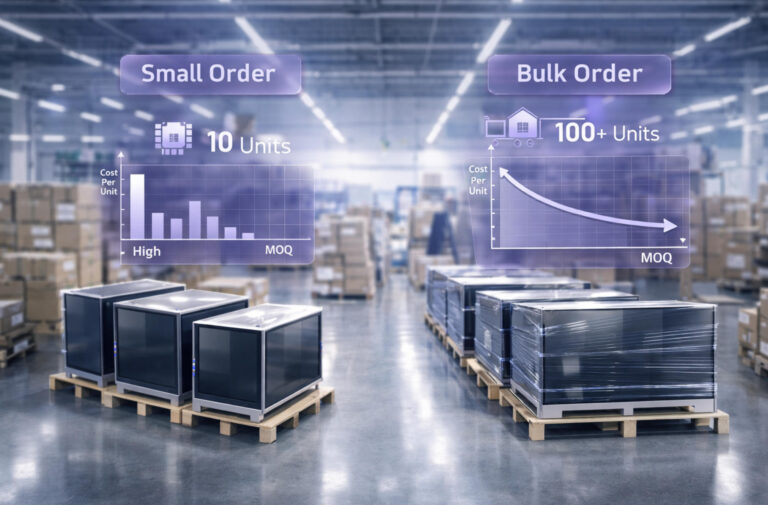
Buying interaktive Displays in bulk is a major decision for many distributors—especially when sourcing from China. MOQ (Minimum Order Quantity) and pricing structure are often the most confusing parts of the process, yet they directly impact your cost, risk, and profitability. Many buyers struggle to understand why factories set MOQs or how pricing is actually calculated behind the scenes. In this guide, I’ll break down the interactive display factory MOQ and wholesale pricing structure in a clear and practical way. You’ll learn why MOQs exist, how to negotiate them effectively, and how to make them work in your favor—while also gaining a deeper understanding of cost structure so you can make smarter, more confident purchasing decisions.
What Is MOQ for Interactive Display Manufacturers?
MOQ, or Minimum Order Quantity, refers to the minimum number of units a manufacturer requires per order. In the interactive display industry, MOQ is not set arbitrarily—it is closely tied to how factories operate and manage production efficiency.
From a factory’s perspective, larger orders are always preferred. This is because production involves fixed costs such as material sourcing, assembly line setup, testing, packaging, and labor coordination. Whether you produce 5 units or 100 units, much of the preparation work remains the same. As a result, small orders consume nearly the same effort but generate significantly lower profit, making them less attractive for manufacturers. This is why factories tend to prioritize bulk orders and set MOQ thresholds.
Es besteht auch ein deutlicher Unterschied zwischen manufacturers and trading companies. Factories typically have higher MOQs because they focus on production efficiency and batch manufacturing. In contrast, trading companies are more flexible—they can sometimes accept smaller quantities by combining orders from multiple clients or sourcing from different factories.
In terms of typical numbers, MOQ for interactive displays usually ranges from 10 to 100 units, depending on factors such as screen size, configuration, and customization level. Standard models often have lower MOQs, while OEM/ODM customized products usually require higher quantities.
Understanding MOQ helps you better plan your purchasing strategy and negotiate more effectively with suppliers.
Factors That Influence MOQ in Interactive Display Production
MOQ for interactive displays is not fixed—it varies based on several production and business factors. Understanding these variables helps you better predict order requirements and negotiate more effectively with manufacturers.
One of the most important factors is Bildschirmgröße. Larger displays such as 86″ or 98″ typically require higher MOQs compared to smaller sizes like 65″ or 75″. This is because large panels are more expensive, harder to source, and require more careful logistics and packaging.
Ein weiterer Schlüsselfaktor ist hardware configuration. High-end setups—such as RK3588 chipsets, OPS modules, built-in cameras, or advanced touch technology—often increase MOQ requirements. Customized hardware involves additional sourcing, testing, and integration, which manufacturers prefer to justify with larger production volumes.
The level of customization (OEM/ODM) also plays a major role. For standard models or widely used configurations, some factories may even accept very small orders—even as low as one unit—because these products are already in regular production. However, once branding, software, or structural changes are introduced, MOQ usually increases to offset development and setup costs.
Endlich, production scheduling and factory workload can influence MOQ. During peak seasons, when factories are fully booked, manufacturers may prioritize large-volume orders. If you need urgent delivery, they may require a higher MOQ to fit your order into their production schedule.
By understanding these factors, you can align your order strategy with factory expectations and secure better terms.
Understanding Wholesale Pricing Structure (Factory Cost Breakdown)
To negotiate effectively with an interactive display factory, you need a clear understanding of the wholesale pricing structure. The final unit price is not arbitrary—it is built from several key cost components.
The largest portion is the BOM (Bill of Materials) cost. This includes the LCD panel, mainboard (e.g., Android board or OPS), touch module, glass, and other electronic components. Among these, the panel alone can account for a significant percentage of the total cost, especially for larger sizes like 86″ or 98″.
Next comes labor and manufacturing costs. These cover assembly, testing, quality control, and factory operations. While China offers competitive manufacturing efficiency, labor and operational costs still play a role in the final pricing, especially for customized or complex configurations.
Packaging and logistics are another important factor. Normally, these costs are relatively stable and predictable. However, external factors—such as geopolitical tensions or disruptions in shipping routes (for example, conflicts affecting Middle East shipping lanes)—can cause sudden increases in ocean freight costs, directly impacting landed prices.
Finally, there is the profit margin. This is where many distributors make a common mistake—simply adding a fixed percentage markup to the purchase price. In reality, your pricing strategy must also account for after-sales service, spare parts, inventory holding costs, and potential risks.
Understanding this pricing structure allows you to calculate more accurate margins and build a sustainable, competitive business model.
Price Differences: Standard Models vs OEM/ODM Custom Orders
Understanding the price difference between standard models and OEM/ODM customized interactive displays is essential for making the right purchasing decision.
Standard models are typically the most cost-effective option. These products are already in mass production, meaning the supply chain—from panels to mainboards and touch modules—is highly optimized. As a result, manufacturers can offer lower prices due to economies of scale, stable sourcing, and reduced production risks. For distributors testing a market or looking for quick turnover, standard models are often the best starting point.
Im Gegensatz, OEM/ODM custom orders involve additional costs. Customization may include branding (logo, packaging), UI design, firmware modifications, or software integration. However, an important advantage is that for large-volume orders, many smart board manufacturers are willing to offer these customizations at very low cost—or even nearly free—because the margin is recovered through scale.
Ein weiterer Schlüsselfaktor ist order quantity. Small-batch orders usually have higher per-unit prices due to setup costs, lower efficiency, and limited bargaining power. On the other hand, large-volume orders benefit from bulk pricing, better component sourcing, and stronger negotiation leverage.
In short, standard models offer lower entry costs, while OEM/ODM solutions provide differentiation and branding advantages—especially when supported by sufficient order volume.
How to Negotiate MOQ and Pricing with Interactive Display Factories
Negotiating MOQ and pricing with interactive display factories is a critical step that can significantly impact your margins and long-term partnership.
Zu reduce MOQ, consider starting with a trial order oder mixed models (mixed container). Many factories are more flexible if you combine different sizes (e.g., 65″ + 75″ + 86″) into one order, allowing you to meet MOQ requirements while testing multiple products. Trial orders also help build trust and demonstrate your intent as a serious buyer.
When negotiating pricing, focus on long-term cooperation rather than one-time deals. Factories are more willing to offer better pricing if they see stable future demand. You can propose a phased order plan (e.g., initial order + follow-up volume), but avoid making unrealistic promises. Many Chinese smart board manufacturers value sincerity—overstating your potential orders without real follow-through can damage trust and weaken your negotiating position.
To avoid overpriced quotations, always compare multiple suppliers. However, effective comparison requires high-quality inquiries. Clearly specify your requirements, including size, configuration, system (Android/OPS), certifications, and customization needs. Vague inquiries often lead to inflated or inconsistent quotes.
It’s also important to note that prices listed on platforms like Alibaba are often not accurate. They are usually indicative or even intentionally adjusted for visibility, not final transaction prices.
In short, clear communication, realistic expectations, and strategic negotiation are key to securing the best terms.
Hidden Costs Buyers Often Overlook
When sourcing interactive displays, many buyers focus only on the unit price—but hidden costs can significantly affect your total investment and profit margins.
One major factor is interactive display certification Kosten. Certifications such as CE certification, FCC certification, and UL certification may already be included for standard models, but for OEM/ODM projects, additional testing or re-certification can generate extra expenses. These costs can be substantial, especially if multiple markets are involved.
Another overlooked expense is tooling and development fees. If your project requires customized enclosures, structural changes, or new features, factories may charge mold fees or engineering costs. These are usually one-time fees but can be high depending on complexity.
After-sales service and spare parts are also critical. Displays are long-term-use products, and you need to account for replacement components, warranty support, and technical service. Ignoring this can lead to unexpected operational costs later.
Endlich, shipping and import costs must be carefully calculated. Ocean freight is generally stable, but it can fluctuate due to external factors such as geopolitical tensions or fuel price changes. In addition, import duties and local taxes vary by country and can significantly impact your landed cost.
Understanding these hidden costs helps you build a more accurate pricing strategy and avoid unexpected financial pressure.
MOQ & Pricing Checklist Before You Place an Order
Before finalizing your bulk purchase, it’s essential to evaluate both MOQ and pricing details carefully. Many buyers focus only on unit price, but overlooking key factors can lead to unnecessary costs, inventory pressure, or compliance issues. A structured checklist helps you make more informed and confident decisions.
Start by assessing whether the MOQ is realistic for your business stage and sales expectations. Next, clarify if customization costs—such as branding, UI, or software—are included in the quotation or charged separately. Certifications are another critical point: always confirm whether required compliance documents are already covered or will incur additional fees. Finally, check if the supplier supports partial shipments, which can significantly improve your cash flow and reduce inventory risks.
Below is a practical checklist to guide your evaluation:
| Checklist Item | What to Check | Why It Matters |
|---|---|---|
| MOQ Reasonable | Matches your budget and sales plan | Avoids overstock and cash flow pressure |
| Customization Costs Included | Branding, UI, software fees clarified | Prevents hidden expenses |
| Certifications Included | CE, FCC, UL, RoHS availability | Ensures compliance and smooth import |
| Partial Shipment Supported | Flexible delivery options | Improves inventory and cash management |



 German
  English
  Spanish
  Arabic
  French
  Indonesian
  Portuguese
  Russian
  Vietnamese
  Thai
Thai  Italian