
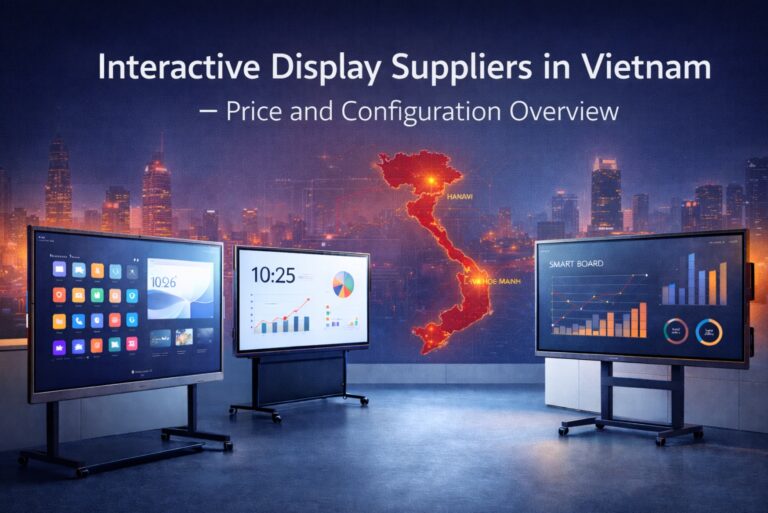
As Vietnam becomes a key destination in the third wave of global industrial relocation, its electronics and display manufacturing capabilities are rapidly moving up the value chain. Between 2025 and 2030, interactive displays are no longer a niche product in Vietnam—they are emerging as a full-fledged industry, driven by strong domestic demand from education, enterprise, and public sectors, while simultaneously being exported to global markets across Southeast Asia, the Middle East, and Europe.
Today, I’d like to give you a concise but practical introduction to Interactive Display Suppliers in Vietnam, helping you understand how this industry is structured, how costs and pricing are formed, and how the entire supply chain operates—from components to final assembly and export.
Vietnam Interactive Display Market Overview: Why Vietnam Is a Fast-Growing Interactive Display Market
Vietnam is rapidly emerging as one of Southeast Asia’s most dynamic interactive display markets, driven by a combination of digital transformation, cost competitiveness, and expanding domestic demand. Although the market size in 2025 is still relatively modest compared with China or mature Western markets, its growth rate is significantly higher, especially across interactive kiosks, whiteboards, and AI powered touch screen displays.
On the demand side, education digitization is the most important driver. Government-backed programs to modernize classrooms and promote digital literacy are accelerating the adoption of interactive flat panels and whiteboards in schools and universities. At the same time, smart offices, retail digitization, and public-sector upgrades—including smart cities, transportation hubs, and government service centers—are pushing demand for interactive kiosks, video walls, and digital signage with touch capabilities. Buyer profiles range from schools and universities to enterprises, government projects, and local system integrators responsible for large-scale deployments.
From a market structure perspective, Vietnam plays a dual role in Southeast Asia: it is both a manufacturing and assembly base and a fast-growing consumption market. Many suppliers assemble interactive displays locally using imported panels and components, enabling competitive pricing and faster regional delivery, while also exporting finished products to ASEAN, the Middle East, and Europe.
As the market scales between 2025 and 2030, understanding cost transparency and supply-chain structure becomes critical. Pricing is shaped not only by hardware, but increasingly by software, content management, and AI-enabled features. For buyers and partners, insight into Vietnam’s local demand versus export-oriented supply dynamics is key to making informed sourcing and investment decisions.
Top 12 Interactive Display Suppliers in Vietnam
| Nombre de la empresa | Company Bio | Línea de productos | Location (City, Vietnam) | Póngase en contacto con |
|---|---|---|---|---|
| Ikinor Vietnam | Ikinor is a professional interactive display and smart board manufacturer from China, with extensive experience supplying Vietnam’s education, enterprise, and system integrator markets. Ikinor Vietnam operates through a China manufacturing + Vietnam local partner model, providing cost-efficient, customizable interactive display solutions compliant with Vietnam market requirements. | Interactive flat panels, smart boards, education displays, corporate collaboration displays, OPS-ready interactive screens, digital signage & kiosks | Ho Chi Minh City (local partners & logistics hub) / Hanoi (education & government project support) |  |
| INNOLUX Việt Nam | Positions itself as a local manufacturer and assembler of smart interactive displays for education and enterprise markets. | Interactive displays, touch screens, video walls, LCD/LED systems | Ho Chi Minh City (southern operations & distribution hub) | https://trangvangvietnam.com |
| BADA VISION | Vietnamese distributor focusing on affordable interactive displays for schools and SMEs. | Interactive touch displays, smart boards | Ho Chi Minh City | https://badadisplay.com |
| KAPAS | Brand offering large-size interactive multimedia displays compliant with international standards. | 75″ interactive displays, multimedia smart screens | Hanoi (brand operations & sales) | https://kapas.vn |
| BNNISC | Supplier of multi-touch interactive displays aimed at improving classroom and office productivity. | Interactive flat panels, multi-touch displays | Hanoi | https://bnnisc.vn |
| HPT Hà Nội (HPT-HN) | IT & AV integrator providing interactive displays as part of digital transformation projects. | Interactive displays (55″–216″), OLED/LCD solutions | Hanoi | https://hpt-hn.vn |
| Vertex Display | Introduces smart interactive displays, including Korean-origin solutions, emphasizing hardware–software integration. | Interactive LED/LCD displays, all-in-one smart boards | Ho Chi Minh City | https://vertex-display.com.vn |
| New One (SOT Smart One) | Provides large-format IR touch interactive displays for classrooms and meeting rooms. | 75″ IR touch interactive displays | Ho Chi Minh City | https://sotsmartone.com |
| Phúc Bình Group | AV solution provider delivering turnkey interactive display projects using multiple global brands. | Interactive displays (55″–86″), AV systems | Ho Chi Minh City | https://phucbinh.com.vn |
| Phương Việt | Long-established importer and distributor active in digital transformation projects nationwide. | Interactive flat panels, smart boards | Ho Chi Minh City | https://phuongviethcm.com |
| SmartRetail | Focuses on high-end interactive displays with AI, cameras, and microphone arrays for retail and enterprise. | 86″ AI interactive displays, smart boards | Ho Chi Minh City | https://smartretail.com.vn |
| SAVITEL | Professional AV integrator serving government, healthcare, and enterprise customers. | Interactive displays, conferencing & AV systems | Hanoi (national project coverage) | https://savitel.com.vn |
Pantalla interactiva Cost Structure & Price Guide in Vietnam
Vietnam’s interactive display market is highly price-sensitive and strongly shaped by supply-chain structure. Most products are either locally assembled using imported panels or fully imported from China, with pricing typically segmented into three clear tiers.
Entry-level interactive displays are mainly education-focused models using Android OS and IR touch. These are widely deployed in public schools and private training centers. In Vietnam, 65″–75″ entry models usually range from ₫25,000,000 to ₫45,000,000, depending on brand, panel origin, and warranty. This tier is significantly more affordable than Thailand and Malaysia, where similar products often start 10–20% higher due to stronger local branding and higher service costs.
Mid-range interactive flat panels serve both education and corporate users and are typically OPS-ready, supporting Android + Windows workflows. Popular sizes (75″–86″) in Vietnam are commonly priced between ₫50,000,000 and ₫80,000,000. By comparison, mid-range products from Thailand suppliers y Malaysia suppliers often fall into a higher band, reflecting higher labor costs and more standardized enterprise service bundles.
High-end interactive displays target enterprises, conference rooms, and government projects. These models feature PCAP táctil, integrated cameras, microphones, and conferencing readiness. In Vietnam, prices for 86″–98″ enterprise models typically start around ₫90,000,000 y puede superar ₫150,000,000 for premium configurations. Comparable high-end systems in Thailand and Malaysia are generally more expensive, particularly when bundled with local SLA contracts.
From a cost-structure perspective, Vietnam benefits from lower local labor costs and flexible assembly, while VAT and import duties still impact landed prices for fully imported units. As a result, Vietnam remains one of the most cost-competitive interactive display markets in Southeast Asia, especially for large-scale education and enterprise deployments.
Supply Chain Analysis: Local Sourcing vs Importing from China
Vietnam’s interactive display supply chain is closely tied to China’s manufacturing ecosystem, and this relationship explains both pricing and availability in the local market. In practice, most interactive display panels sold in Vietnam originate from Fabricantes chinos, even when they are marketed as local or regional brands.
The key reason is component concentration. Core parts of smart boards and interactive displays—such as metal backplates, LCD modules, touch frames, control boards, processors, power modules, and OPS-compatible mainboards—are predominantly produced in China. China’s mature electronics clusters provide scale, component availability, and rapid iteration that are difficult for other countries to replicate. As a result, even Vietnam-assembled products typically rely on Chinese upstream suppliers for critical hardware.
From a cost perspective, buyers often see a 30–50% price difference between factory-direct sourcing from China y branded retail products sold locally. Factory-direct models reduce brand premiums, multiple distributor markups, and redundant logistics costs. This cost gap becomes especially significant for education tenders and multi-site enterprise deployments.
In terms of logistics, the most common supply routes are:
- China → Vietnam by sea, used for bulk shipments and large projects, offering lower per-unit costs.
- China → Vietnam by road, particularly from Southern China to Northern Vietnam, favored for faster delivery and flexible replenishment.
Vietnam’s advantage lies in local assembly and branding. By assembling final units locally, suppliers can shorten delivery times, customize software language and branding, simplify after-sales service, and respond quickly to project-based demand. This hybrid model—Chinese components + Vietnamese assembly and integration—has become the most practical and cost-efficient supply strategy for Vietnam’s interactive display market.
OEM / ODM Customization & SKD/CKD Options for Vietnam Buyers
For Vietnam buyers looking to build differentiation or control costs, OEM / ODM customization and SKD/CKD assembly models have become increasingly popular in the interactive display market. Instead of simply reselling off-the-shelf products, many Vietnamese companies now work directly with manufacturers to create end-to-end customized solutions.
A major advantage of OEM/ODM is branding and software customization. Vietnamese distributors or local brands can request full private-label solutions, including custom logo printing, boot screens, bezel design, and fully localized Vietnamese UI systems. Beyond language, manufacturers can customize launcher interfaces, pre-install education or meeting apps, and even align UI layout with the buyer’s brand identity. For local companies aiming to establish their own interactive display brand, this approach enables faster market entry with a professional, unified product image.
From a hardware perspective, OEM/ODM projects allow flexible OPS configurations (Intel i5/i7, RAM, SSD), as well as optional integrated cameras, microphone arrays, speakers, and customized wall mounts or mobile stands to match classroom or meeting-room use cases.
Vietnam buyers also increasingly adopt SKD (Semi Knocked Down) o CKD (Completely Knocked Down) options. In this model, core components—such as panels, backplates, touch modules, and mainboards—are shipped from China, while final assembly, testing, and branding are completed locally. This can reduce import costs, improve delivery speed, and simplify after-sales service.
En términos de MOQ and lead time, OEM/ODM projects typically start from 20–50 units per size, with production lead times of 4–6 weeks, plus logistics time. For larger education or enterprise projects, these models offer the best balance between cost, customization, and supply-chain flexibility.
How to Find and Select the Right Interactive Display Suppliers in Vietnam
Choosing the right interactive display supplier in Vietnam depends largely on project size, budget, and service expectations. For small to mid-size education or enterprise projects, local distributors are often the best option. They provide faster delivery, local-language support, on-site installation, and easier warranty handling. This is especially important for schools and government buyers that require responsive after-sales service and local invoicing.
For large-scale deployments, branding projects, or price-sensitive tenders, direct factory sourcing—often from China with local Vietnam assembly—can be more competitive. Factory-direct sourcing typically offers 30–50% lower hardware cost, flexible specifications, and OEM/ODM customization, but it requires stronger supply-chain management and a local partner for installation and support.
When researching suppliers, buyers usually start with search engines and B2B platforms, using both Vietnamese and English keywords. Understanding common search terms helps identify real manufacturers versus pure traders.
Common Interactive Display Search Keywords (Vietnam / English)
| Categoría | Vietnamese | English |
|---|---|---|
| Pantalla interactiva | màn hình tương tác | pantalla interactiva |
| Manufacturer | nhà sản xuất màn hình tương tác | interactive display manufacturer |
| Factory | nhà máy màn hình tương tác | interactive display factory |
| Supplier | nhà cung cấp màn hình tương tác | interactive display supplier |
| Pizarra interactiva | bảng tương tác | pizarra interactiva |
| Education whiteboard | bảng tương tác cho giáo dục | interactive whiteboard for education |
| All-in-one panel | màn hình tương tác all-in-one | all-in-one interactive panel |
| OEM sourcing | OEM màn hình tương tác Việt Nam | OEM interactive display Vietnam |
Beyond price, professional buyers should evaluate total cost of ownership (TCO)—including hardware cost, installation, software licenses, warranty length, spare parts availability, and long-term maintenance.
Final Procurement Checklist (Vietnam Buyers)
- Local support or system integrator available
- Clear warranty & SLA terms
- Software language (Vietnamese) compatibility
- Compliance with education or government requirements
- Scalable supply for future expansion
A structured evaluation approach ensures reliable performance, predictable costs, and long-term project success in Vietnam’s growing interactive display market.
Preguntas frecuentes
No. Most interactive displays sold in Vietnam are manufactured in China or use core components from China, including LCD panels, touch modules, mainboards, OPS PCs, and camera modules. Vietnam mainly focuses on local assembly, branding, distribution, and after-sales service, rather than full upstream manufacturing.
China offers significant cost advantages (30–50%), mature supply chains, wider model selections, and strong OEM/ODM capabilities. For large projects or private-label brands, importing from China allows buyers to customize specifications, software UI, and branding at a much lower unit cost than buying international retail brands locally.
Interactive displays are shipped via:
Road transport (Southern China → Northern Vietnam, fastest for bulk orders)
Sea freight (Shenzhen / Guangzhou → Hai Phong or Ho Chi Minh City)
Sea + road combination for cost optimization
Lead times typically range from 10–25 days, depending on order size and customization.
Buyers should account for:
Import duty (often low or reduced for electronics under ASEAN–China agreements)
VAT (10%)
Customs clearance fees and logistics costs
Many buyers reduce tax exposure by using SKD/CKD assembly or working with experienced import agents.





 Spanish
  English
  Arabic
  French
  Indonesian
  German
  Portuguese
  Russian
  Vietnamese
  Thai
Thai  Italian