
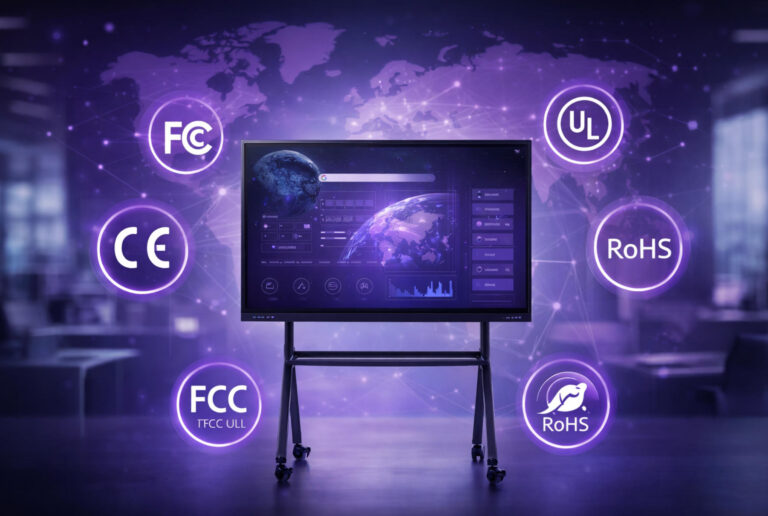
When you’re preparing for a public tender, managing a large-scale project, or planning to become a distributor, one thing you simply can’t ignore is interactive display certifications. In highly regulated markets like the European Union and the United States, electronic products must comply with strict standards before they can be imported, sold, or deployed. Without the right certifications, even the best product can be rejected at customs or disqualified from bidding. In this guide, I’ll walk you through the key certifications behind interactive displays—so when you communicate with a produsen papan pintar, you’ll clearly understand what each certification means, why it matters, and how it directly impacts your project success.
What Certifications Are Required for Interactive Displays?
Before purchasing or importing an tampilan interaktif, it’s essential to understand the core certification categories that ensure compliance, safety, and market access. These certifications are generally grouped into four key areas: Safety, EMC (Electromagnetic Compatibility), Wireless, and Environmental. Each category plays a different role in ensuring the product can be legally sold and reliably used in various regions.
Below is a simplified overview of the most important certifications you’ll encounter when sourcing from a smart board manufacturer:
| Sertifikasi | Kategori | Main Purpose |
|---|---|---|
| CE | Safety / EMC / Wireless | Required for the European market; ensures compliance with safety, EMC, and radio standards |
| FCC | EMC / Wireless | Required in the U.S.; regulates electromagnetic interference and wireless communication |
| UL | Safety | Verifies electrical safety and reduces the risk of fire or electric shock in U.S. markets |
| RoHS | Environmental | Restricts hazardous materials such as lead and mercury in electronic products |
In short, these certifications are not just technical requirements—they are your gateway to entering global markets. Understanding them early helps you avoid compliance risks, delays, and costly mistakes when dealing with suppliers.
Why Certifications Matter Before You Place a Bulk Order
Before placing a bulk order for interactive displays, certifications are not just a checkbox—they directly impact whether your products can be imported, sold, and accepted in your target market. Ignoring certification requirements can lead to costly and sometimes irreversible consequences.
First, there is the risk of customs clearance failure. In markets like the EU and the U.S., products without proper certifications such as CE certification or FCC certification may be detained, rejected, or even destroyed at the port. This results in financial losses, delayed deliveries, and potential damage to your supply chain reliability.
Second, certifications are often a mandatory requirement for tenders, especially in government, education, and enterprise procurement projects. Without valid compliance documentation, your bid may be disqualified before technical evaluation even begins.
Third, there are product safety and legal liabilities. If a non-compliant device causes electrical hazards, signal interference, or operational failures, the importer or distributor may face lawsuits, penalties, or compensation claims.
Finally, certifications are essential for building trust and long-term business relationships. Buyers rely on them as proof of product quality and regulatory compliance.
For example, a Germany-based interactive display supplier once lost a large education contract because their CE documentation did not fully align with regulatory requirements, despite having competitive pricing.
Certifications are not optional—they are your ticket to enter the market.
Certification Requirements by Market: US, EU, Middle East & Asia
Certification requirements for interactive displays vary significantly by region, and understanding these differences is critical for successful importing and project execution. Targeting the right certifications also helps you capture search traffic such as interactive display certification USA, Europe compliance requirementsdan India import regulations.
In the United States 🇺🇸, the key certifications are FCC certification and UL certification. FCC ensures that the device does not cause harmful electromagnetic interference, while UL focuses on electrical safety. Both are essential for commercial deployment and large-scale projects.
In the European Union 🇪🇺, compliance is more comprehensive. Products must carry CE certification, which covers safety, EMC, and sometimes wireless requirements. Additionally, RoHS certification ensures environmental compliance, and RED is required if the device includes wireless functions such as WiFi or Bluetooth.
In the Middle East 🇸🇦, particularly Saudi Arabia, SABER certification is mandatory for customs clearance. Without it, shipments cannot legally enter the market, making it a critical step for regional distributors.
In India 🇮🇳, BIS certification is a major barrier for many importers. Many Indian interactive display companies face delays or restrictions due to incomplete BIS registration, which is required for electronic products entering the country.
Understanding these regional requirements helps you avoid delays, reduce compliance risks, and expand globally with confidence.
How to Verify Interactive Display Certifications (Step-by-Step Guide)
Verifying certifications is one of the most critical steps before purchasing interactive displays—yet it is often overlooked. Many buyers assume that receiving a PDF means compliance, but that’s not always the case. You must verify the authenticity and validity of every certification.
Step 1: Check the Certificate Number
Every legitimate certificate includes a unique Certificate No. This number should be clearly visible and traceable. If a supplier cannot provide it, that’s an immediate red flag.
Step 2: Confirm the Exact Model Match
Ensure the certificate applies to the exact product model you are purchasing—not a similar or previous version. Certifications are not “universal” and cannot be shared across different models without proper evaluation.
Step 3: Verify Through the Issuing Authority
Go to the official website of the issuing body (such as for FCC certification or CE certification) and search for the certificate number. Authentic certifications are always traceable in official databases.
Step 4: Distinguish Test Reports vs Certifications
Many suppliers provide lab test reports instead of actual certifications. While reports show testing results, they do not equal compliance approval.
Many suppliers provide reports, not real certifications.
Step 5: Check Validity and Expiry
Some certifications require updates due to regulatory changes. Always confirm that the certificate is still valid and up to date.
By following these steps, you can confidently avoid fake documents, reduce compliance risks, and ensure your products meet market requirements.
Common Certification Mistakes Buyers Should Avoid
When sourcing interactive displays, many buyers assume certifications are straightforward—but small mistakes can lead to major losses. Understanding common pitfalls can save you time, money, and failed projects.
Mistake 1: Treating Test Reports as Certifications
Some suppliers provide lab test reports instead of official certifications like CE certification. A test report only shows results—it does not grant compliance. One buyer imported a full container based on reports, only to have the shipment held at customs.
Mistake 2: Ignoring Wireless Module Certification
If your interactive display includes WiFi or Bluetooth, it must comply with regulations such as FCC certification or RED in Europe. A retail project once failed deployment because the built-in wireless module was not certified, even though the main unit was.
Mistake 3: Assuming One Certification Covers All Sizes
Certifications are often model-specific. A Layar interaktif 65 inci certification may not automatically apply to a 75 inci atau 86 inci version. A distributor faced delays after realizing larger sizes were not included in the certification scope.
Mistake 4: Using Expired Certificates
Regulations evolve, and outdated certifications may no longer be valid. Some buyers unknowingly use expired documents, risking rejection during audits or customs inspections.
Mistake 5: ODM Branding Mismatch
When rebranding (OEM/ODM), the certificate must match the product name, model, and manufacturer. A mismatch can invalidate the certification entirely.
Avoiding these mistakes ensures smoother imports, stronger compliance, and higher success rates in competitive projects.
Interactive Display Certification Checklist (Before You Buy)
Before placing a bulk order, use this checklist to quickly evaluate whether your supplier meets essential certification requirements. This helps reduce compliance risks and ensures smoother project execution.
| Checklist Item | What to Verify | Why It Matters |
|---|---|---|
| CE / FCC / UL Certifications | Confirm the supplier provides valid CE certification, FCC certification, and UL certification documents | Required for market entry in EU and US; ensures safety and compliance |
| Wireless Certification Included | Check if WiFi/Bluetooth modules comply with RED (EU) or FCC (US) | Prevents deployment issues for connected devices |
| RoHS Compliance Report | Verify availability of RoHS certification documentation | Mandatory for environmental compliance in many regions |
| Original Certificate PDF Available | Request official certificates with certificate numbers and issuing body details | Helps confirm authenticity and avoid fake documents |
| Certification Matches Product Model | Ensure certificates correspond exactly to the model and size you are purchasing | Avoids invalid certification issues during inspection |
| Support for Project-Specific Certifications | Ask if the supplier can assist with additional certifications (e.g., local or tender-specific) | Critical for government, education, and enterprise projects |
Do OEM/ODM Interactive Displays Require New Certifications?
Whether OEM/ODM interactive displays require new certifications depends on how much the product is modified from the original design. Many buyers assume they can simply rebrand an existing model and reuse the same certificates—but this is not always true.
In general, re-certification is required if there are significant changes, such as structural design modifications, different mainboards, or power supply adjustments. Even small hardware changes can affect safety or electromagnetic performance, which may invalidate existing approvals. For example, switching to a new motherboard or chipset can impact EMC behavior, requiring updated compliance testing.
Wireless components are another critical factor. If the WiFi or Bluetooth module is changed, certifications related to radio frequency—such as FCC or RED—must be reassessed. This is one of the most commonly overlooked issues in OEM projects.
A frequent misconception among OEM buyers is believing that branding changes alone do not affect certification. While logo changes are usually acceptable, model names, manufacturer details, and technical specifications must still match the certification documents. Any mismatch can lead to compliance issues during customs clearance or project audits.
This is why choosing a reliable interactive display OEM/ODM partner is essential. An experienced manufacturer understands certification boundaries, can advise whether re-testing is needed, and may already have modular certifications in place to reduce time and cost.
In short, OEM flexibility is valuable—but compliance must always come first.



 Indonesian
  English
  Spanish
  Arabic
  French
  German
  Portuguese
  Russian
  Vietnamese
  Thai
Thai  Italian