

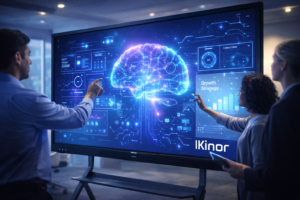
At ISE 2026, the interactive display exhibition area made one thing clear: AI is no longer a future concept—it is the new competitive battlefield. Major manufacturers such as Hisense and Dahua are actively positioning themselves around the concept of AI-powered interactive displays, signaling a decisive shift from traditional smart boards to intelligent collaboration hubs. What was once a simple touch-based presentation tool has evolved into a data-driven, AI-enhanced communication platform. From smart voice control and auto-framing cameras to real-time whiteboard recognition and cloud integration, AI is redefining how classrooms, meeting rooms, and retail spaces operate. As adoption accelerates across education, corporate, and commercial sectors, choosing the right AI-powered interactive display has become a strategic decision rather than just a hardware upgrade.
Why Is AI Transforming Interactive Displays and Smart Boards?
With the rapid advancement of artificial intelligence and high-performance computing chips, interactive displays and smart boards are entering a new AI-driven era. In the past, smart boards primarily focused on touch interaction—essentially functioning as large touchscreens with writing capabilities. While they could display content and support annotations, they lacked the ability to truly understand user behavior or adapt to different usage scenarios. This exposed a critical limitation: the device could display information, but it could not interpret, analyze, or actively improve collaboration efficiency. In classrooms and meeting rooms, the display was merely a passive tool rather than an intelligent participant.
The integration of AI directly addresses this core issue. Through features such as voice recognition, auto-framing cameras, speaker tracking, AI-powered whiteboard recognition, and real-time data analysis, interactive displays now possess the ability to “perceive and respond.” The evolution from simple touch interaction to intelligent collaboration transforms the display into a smart hub that enhances workflows, supports decision-making, and improves engagement.
Today, education, corporate environments, and retail sectors are leading the adoption of AI-powered interactive displays. Schools leverage AI to optimize classroom interaction and content management; enterprises enhance hybrid meeting efficiency; and retail businesses use intelligent analytics to create more engaging customer experiences. AI has become the defining competitive factor in next-generation commercial display technology.
Key Features to Look for in AI-Powered Interactive Displays
When selecting an AI-powered interactive display, businesses should look beyond screen size and resolution and focus on how AI capabilities truly enhance collaboration. One essential feature is AI voice control and smart assistant integration. With voice commands, users can open files, switch applications, or start meetings without manual navigation, creating a smoother classroom or conference experience.
Auto-framing cameras and intelligent speaker tracking are equally important, especially in hybrid meeting or remote learning environments. The system can automatically detect the active speaker, adjust the camera focus, and combine AI noise reduction and echo cancellation to significantly improve communication quality.
AI-powered whiteboard recognition is another key capability. The system can convert handwritten notes into editable digital text, allowing content to be saved, organized, and shared instantly. Advanced models also support AI translation and AI document summarization, enabling real-time transcription and automatic meeting summaries to boost productivity.
In addition, smart content optimization and cloud collaboration are critical for modern workplaces. AI can automatically adjust display performance based on usage scenarios while enabling multi-device sharing. Some high-end models even include creative AI image generation tools, supporting interactive teaching, brainstorming sessions, and visual content creation to enhance engagement and innovation.
Top 8 AI-Powered Interactive Display Models in 2026
SMART Board MX075-V5
| Specification | Details |
|---|---|
| Display Size | 75″ 4K UHD |
| Price | US$3,644.99 |
| Operating System | Android 13 |
| Processor | Octa-core SoC |
| RAM / Storage | 8GB / 64GB |
| AI Features | HyPr Touch (32-point), AI-enhanced whiteboard tools, microphone array |
| Target Market | Education, Corporate Meeting Rooms |
| Positioning | Premium collaboration display |
Samsung WAD65 Interactive Display
| Specification | Details |
|---|---|
| Display Size | 65″ 4K UHD |
| Price | US$1,590.00 |
| Operating System | Samsung Customized Android |
| Processor | Octa-core platform |
| RAM / Storage | 4GB–8GB / 32GB–64GB |
| AI Features | Smart handwriting recognition, wireless screen sharing |
| Target Market | K12 Education |
| Positioning | Entry-level AI classroom display |
Hisense 75″ GoBoard
| Specification | Details |
|---|---|
| Display Size | 75″ 4K UHD |
| Price | US$2,605.99 |
| Operating System | Android 13 |
| Processor | Hisense AI SoC |
| RAM / Storage | 8GB / 64GB |
| AI Features | Voice assistant, intelligent collaboration tools |
| Target Market | Enterprise & Education |
| Positioning | Mid-range AI meeting display |
ViewSonic IFP6552-1C ViewBoard
| Specification | Details |
|---|---|
| Display Size | 65″ 4K UHD |
| Price | US$2,249.00 |
| Operating System | Android |
| Processor | Octa-core SoC |
| RAM / Storage | 4GB–8GB |
| AI Features | Smart annotation, multi-screen collaboration |
| Target Market | Classroom & Business |
| Positioning | Education-focused collaboration display |
Optoma Creative Touch 75″
| Specification | Details |
|---|---|
| Display Size | 75″ 4K UHD |
| Price | ~US$1,602.95 (discounted) |
| Operating System | Android 13 |
| Processor | Octa-core SoC |
| RAM / Storage | 8GB / 64GB |
| AI Features | AI noise reduction (8-mic array), smart meeting optimization |
| Target Market | Small & Mid-size Meeting Rooms |
| Positioning | Budget-friendly AI collaboration board |
Yealink MeetingBoard Pro 75″
| Specification | Details |
|---|---|
| Display Size | 75″ 4K UHD |
| Price | US$6,999.00 |
| Operating System | Android + Microsoft Teams Integration |
| Processor | Enterprise-grade AI platform |
| RAM / Storage | 8GB+ |
| AI Features | Auto-framing camera, speaker tracking, AI voice enhancement |
| Target Market | Enterprise Hybrid Meetings |
| Positioning | High-end AI meeting solution |
LG CreateBoard (65″–98″)
| Specification | Details |
|---|---|
| Display Size | 65″ / 86″ / 98″ |
| Price | ~US$8,857.99 (high-end models) |
| Operating System | Android |
| Processor | Commercial-grade SoC |
| RAM / Storage | 8GB+ |
| AI Features | AI-assisted writing, cloud collaboration tools |
| Target Market | Large Classrooms & Corporate Spaces |
| Positioning | Premium large-format AI display |
Ikinor RK3588 AI-Powered Interactive Display
| Specification | Details |
|---|---|
| Display Size | 75″ / 86″ |
| Price | ~US$2,000 |
| Operating System | Android 13 |
| Processor | RK3588 High-Performance AI SoC |
| RAM / Storage | 8GB / 128GB (configurable) |
| AI Features | AI voice control, whiteboard recognition, smart collaboration tools |
| Target Market | Education, Enterprise, OEM/ODM Clients |
| Positioning | Cost-effective AI-powered OEM solution |
How to Choose the Right AI Interactive Display for Your Business
Selecting the right AI interactive display requires balancing budget, functionality, and long-term deployment strategy. For large-scale projects, decision-makers must look beyond the initial purchase price and evaluate the total value delivered over time. High-end AI features such as auto-framing cameras, voice control, AI-powered whiteboard recognition, and cloud collaboration tools can significantly improve productivity—but only if they align with your real usage needs. The key is finding the right balance between essential features and cost efficiency.
Different environments demand different configurations. Classrooms typically prioritize durability, multi-touch capability, screen visibility, and easy content sharing. Meeting rooms focus more on hybrid collaboration features such as AI speaker tracking, noise reduction, and seamless video conferencing integration. Retail environments may emphasize interactive engagement, digital signage integration, and data analytics capabilities. Choosing the wrong configuration can lead to underutilized features or unnecessary overspending.
OEM customization is another critical factor, especially for distributors, integrators, and brand owners. Custom firmware, logo branding, camera modules, I/O configurations, and software integration can differentiate your offering in competitive markets. For large-scale deployment, we strongly recommend partnering with a professional Chinese smart board manufacturer. This approach allows businesses to optimize pricing, customize hardware and software solutions, and ensure scalable production capacity—ultimately achieving the best balance between performance, cost control, and long-term growth.
Future Trends: Where AI Displays Are Heading
AI-powered interactive displays are rapidly evolving, and the next phase of development will be driven by smarter processing, deeper data integration, and continuous software iteration. One major trend is the rise of edge AI processing. Instead of relying solely on cloud-based computing, displays are increasingly equipped with powerful onboard AI chipsets that can process voice commands, image recognition, and real-time collaboration tasks locally. This improves speed, enhances data privacy, and reduces network dependency.
Another key direction is AI-driven analytics and user behavior insights. Future displays will not only facilitate interaction but also collect and analyze usage data—such as meeting participation patterns, classroom engagement levels, or retail interaction metrics. These insights can help organizations optimize workflows, teaching effectiveness, or marketing strategies.
Integration with enterprise systems such as LMS (Learning Management Systems), ERP, and CRM platforms will also become more seamless. Interactive displays will function as intelligent endpoints within larger digital ecosystems, synchronizing data across departments and platforms.
Importantly, while hardware performance will continue to improve and specifications will rise year after year, this does not mean organizations must frequently replace their devices. In most real-world scenarios, even models released several years ago remain fully capable of meeting core classroom or meeting room needs. Continuous software updates and modular upgrades ensure long-term usability, making AI displays a sustainable and future-ready investment rather than a rapidly obsolete device.




 English
  Spanish
  Arabic
  French
  Indonesian
  German
  Portuguese
  Russian
  Vietnamese
  Thai
Thai  Italian