

In recent years, the demand for smart displays in education has grown rapidly as schools, universities, and training institutions continue to invest in digital learning environments. By 2025, this trend has not only accelerated—it has reshaped how classrooms function around the world. Interactive flat panels, cloud-based collaboration tools, and AI-powered education platforms are now becoming standard across modern learning spaces.
This updated 2025 analysis explores how smart displays are transforming the education sector—highlighting key market trends, leading brands, regional adoption rates, and future growth projections. Whether you’re an educator, technology integrator, or procurement officer, this report will help you understand where the education display market is heading—and how to make informed decisions in a rapidly evolving landscape.
Global Smart Board Market Overview
As of 2025, one trend is unmistakable—everything is getting smarter and more AI-integrated. Just as the 2000s focused on getting online, the 2020s are about bringing intelligence into everyday tools. This shift is fueling rapid growth in the smart board industry, also known as the interactive whiteboard (IWB) market.
According to Straits Research, the global smart board market was valued at USD 5.58 billion in 2024 and is projected to reach USD 9.54 billion by 2033, with a CAGR of 5.9%. The education sector continues to drive the most demand, and North America remains the dominant regional market. Meanwhile, China plays a critical role behind the scenes, manufacturing nearly 70% of the world’s smart boards.
Another forecast projects even stronger growth—from USD 4.90 billion in 2025 to USD 9.79 billion by 2034, reflecting a CAGR of 8.0%.
Leading Countries Driving Growth in the Smart Display Market
As digital classrooms and hybrid offices become the norm, the demand for smart displays—such as interactive whiteboards and panels—is growing worldwide. While developed markets continue to expand, many emerging countries are now becoming key players in driving global demand. Let’s take a closer look at six standout countries contributing to this trend.
Philippines
The Philippines is experiencing rapid digitalization in both public and private education. With government-led smart classroom initiatives and rising tech adoption in private schools, demand for affordable, durable smart boards is growing fast. Local Philippines Smart Board distributors often rely on imports from China and Korea, making it a strategic market for value-oriented suppliers.
Malaysia
Malaysia’s push toward becoming a regional education hub has accelerated its investment in smart learning tools. Both public universities and private schools are adopting interactive displays, and the corporate sector is following suit. Malaysia prefers brands that balance modern features with competitive pricing.
Brazil
As one of the largest economies in Latin America, Brazil is scaling up digital education and smart office transformation. Import tariffs remain a challenge, but demand is strong—especially in urban schools and multinational companies. Local partners and OEM solutions are often key to entry.
Russia
Despite global complexities, Russia continues to invest in educational technologies. Many schools are upgrading classrooms with touch displays, and local integrators seek cost-effective, locally supported brands. Russian buyers often value robust hardware over software ecosystems.
Indonesia
Indonesia’s massive student population and digital literacy push make it a booming market. Government tenders and large-scale public school procurement programs are frequent, favoring reliable and scalable smart display solutions.
India
India leads the smart display demand in Asia, driven by ed-tech, government initiatives like “Digital India,” and a fast-growing reseller ecosystem. If you’re targeting India, be sure to check our India Smart Board Supply Chain Guide for distributor networks and OEM opportunities.
Top Smart Display Technologies in Education
In 2025, smart display technology in education continues to evolve rapidly. While standard features like infrared and capacitive touch, 4K resolution, multi-touch support, and wireless screen mirroring remain essential, the real breakthroughs are now coming from AI integration.
More and more Chinese smart board manufacturers are investing in AI-powered interactive displays. These next-generation systems go beyond basic touch interaction by incorporating facial recognition, voice commands, and adaptive content suggestions. For example, some displays can recognize teachers as they enter the room, automatically loading personalized lesson files or settings.
AI voice assistants built into the smart boards allow teachers to switch slides, launch apps, or adjust volume using simple voice prompts—making hands-free teaching a reality. Additionally, some platforms are being equipped with real-time translation, AI handwriting recognition, and gesture control, which further enhance interactive learning for multilingual or remote classrooms.
Other important technical advancements include:
- Edge computing for faster on-device processing and privacy protection
- Eye-protection features like blue light filtering and auto-brightness adjustment
- Smart sensors for ambient light, presence detection, and energy-saving auto sleep modes
- Cloud platform integration for collaborative whiteboarding and remote class delivery
As AI becomes a standard in modern classrooms, selecting a smart board that supports intelligent interaction—not just display—is becoming the new priority. Schools looking to stay ahead should now consider AI functionality as a key buying criterion.
Classroom Use Cases and Application Scenarios
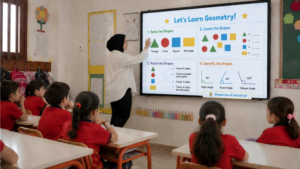
Smart displays have become central to modern classroom teaching. In interactive lessons, teachers can write, annotate, and display multimedia content directly on the screen—enhancing student engagement. For remote learning, smart boards support video conferencing, screen sharing, and real-time collaboration with students at home. In group work, students can connect their devices to brainstorm on the shared screen simultaneously. Many schools also use smart displays for presentations, quizzes, and gamified learning, making classes more dynamic. Some displays support split-screen mode, enabling multitasking—such as showing videos while taking notes. These flexible scenarios prove that smart boards are not just digital whiteboards—they’re complete teaching hubs.
Now, let’s take a quick look at a video that shows these real classroom applications.



 English
  Spanish
  Arabic
  French
  Indonesian
  German
  Portuguese
  Russian
  Vietnamese
  Thai
Thai  Italian