
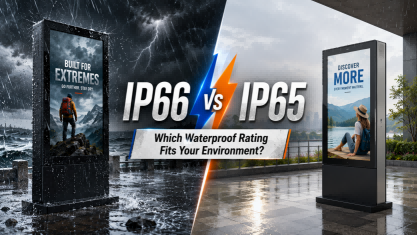
Muitos compradores B2B escolhem a sinalização digital externa priorizando o tamanho da tela, o brilho e o preço, mas classificação de impermeabilidade Muitas vezes, é o monitor que determina se ele continuará confiável após meses de chuva, poeira, umidade e exposição ao ar livre. Ao comparar, é importante considerar esses fatores. Sinalização digital externa IP65 vs IP66A questão principal não é simplesmente qual classificação é mais alta, mas sim qual delas se adequa melhor ao ambiente de instalação real. A classificação IP65 pode ser adequada para fachadas de lojas cobertas, entradas semiabertas ou locais com exposição moderada à chuva. Já a classificação IP66 geralmente é mais segura para ruas expostas, terminais de transporte público, áreas costeiras, pistas de drive-thru ou locais sujeitos a jatos de água mais fortes. Este guia explica a diferença entre IP65 e IP66, os tipos comuns de sinalização digital externa, cenários de aplicação e as principais especificações que os compradores B2B devem verificar antes de fazer o pedido.
Por que a classificação de impermeabilidade é importante para projetos de sinalização digital externa?
A sinalização digital externa enfrenta condições que os displays comerciais internos jamais enfrentarão. Uma tela instalada perto da fachada de uma loja, na beira da estrada, em um ponto de ônibus ou em uma pista de drive-thru pode ficar exposta à chuva, poeira, umidade, vento, luz solar, água de limpeza e longos horários de funcionamento.
É por isso que o classificação de impermeabilidade Não se trata apenas de uma especificação menor. Se o nível de proteção for muito baixo, água ou poeira podem entrar no gabinete e afetar os componentes internos. Com o tempo, isso pode causar operação instável, falha da tela, corrosão, curto-circuito ou necessidade de manutenção mais frequente.
O termo "à prova d'água" também pode ser enganoso. Uma vitrine sob uma fachada coberta não enfrenta o mesmo risco que uma tela publicitária à beira da estrada ou um quiosque ao ar livre exposto à chuva direta e a respingos de água mais fortes.
Para compradores B2B, a sinalização digital externa não deve ser escolhida apenas com base no tamanho da tela, brilho ou preço. A classificação IP adequada deve ser compatível com o ambiente real de instalação, a exposição às intempéries, o método de limpeza e o plano de manutenção.
Entendendo as diferenças entre as classificações IP65 e IP66 para sinalização digital externa.
Um Classificação IP É uma forma padrão de descrever o quão bem uma caixa protege os componentes internos contra poeira e água. Para sinalização digital externa, essa classificação é importante porque o display não apenas exibe conteúdo; ele também protege placas de alimentação, cabos, reprodutores de mídia, módulos de toque, sensores e outras peças eletrônicas da exposição ao ambiente externo.
O código IP geralmente possui dois números. O primeiro número refere-se à proteção contra sólidos, como poeira. O segundo número refere-se à proteção contra água. IP65 e IP66, o primeiro dígito é o mesmo: 6Isso significa que ambas as classificações oferecem forte proteção contra poeira. A principal diferença está no segundo dígito: 5 ou 6, o que demonstra quanta exposição à água o invólucro foi projetado para resistir.
| Parte do código | Significado | Relevância para sinalização digital externa |
|---|---|---|
| Primeiro dígito | Proteção contra sólidos e poeira. | Expositores externos precisam de forte proteção contra poeira em ruas, estações, áreas secas e espaços públicos. |
| Segundo dígito | Proteção contra infiltração de água | Isso determina o desempenho do visor em condições de chuva, respingos ou jatos de água. |
Para Sinalização digital externa IP65A estrutura é à prova de poeira e protegida contra jatos de água de baixa pressão. Isso pode ser adequado para fachadas de lojas cobertas, entradas semiabertas, áreas externas de shoppings ou locais onde a tela possa ficar exposta à chuva, mas não diretamente a jatos de água fortes por longos períodos.
Para Sinalização digital externa IP66A estrutura também é à prova de poeira, mas possui uma proteção mais robusta contra jatos de água. Isso a torna mais adequada para ruas expostas, painéis publicitários à beira da estrada, quiosques externos, terminais de transporte público, pistas de drive-thru ou locais sujeitos a chuvas fortes, ventos intensos ou jatos de água de limpeza mais potentes.
| Recurso | Sinalização digital externa IP65 | Sinalização digital externa IP66 |
|---|---|---|
| Proteção contra poeira | À prova de poeira | À prova de poeira |
| Proteção contra água | Jatos de água de baixa pressão | Jatos de água potentes |
| Adequado para | Áreas cobertas ou semiabertas, chuva leve, fachadas de lojas | Áreas externas expostas, chuva forte, respingos intensos, ambientes mais hostis |
| Não foi projetado para | Lavagem ou imersão em alta pressão | Imersão de longo prazo |
| Decisão do comprador | Custo-benefício para exposição moderada ao ar livre | Mais seguro para projetos externos mais exigentes. |
No entanto, a classificação IP66 não significa que o monitor possa ser submerso em água. Também não significa automaticamente que o produto seja resistente à corrosão, calor extremo, danos causados pela luz solar ou impactos. Esses fatores dependem do material da estrutura, do sistema de refrigeração, da estrutura do vidro, do revestimento, do método de instalação e da engenharia em geral.
A escolha certa depende do ambiente real de instalação. Se o display for instalado sob uma cobertura ou atrás de uma proteção parcial, IP65 pode ser suficiente. Se for instalado em uma área totalmente exposta à beira da estrada, praça pública, estação de transporte público, local costeiro ou quiosque ao ar livre, IP66 costuma ser a opção mais segura.
Para projetos complexos ao ar livre, os compradores B2B devem confirmar não apenas a classificação IP, mas também se a unidade completa, os pontos de entrada de cabos, as portas de acesso, os módulos de toque e a estrutura de instalação foram projetados para as condições externas esperadas.
Tipos comuns de sinalização digital externa e suas necessidades de proteção
A classificação de impermeabilidade exigida para sinalização digital externa depende muito de como o display é usado, onde está instalado e quanta exposição ao ar livre ele recebe.
| Tipo | Uso típico | Recurso principal | Necessidades de proteção | Direção recomendada para classificação de IP |
|---|---|---|---|---|
| Painéis publicitários digitais | Rodovias, estradas principais, locais para publicidade externa | Publicidade em grande escala, alto brilho, rotação dinâmica de anúncios. | Chuva, poeira, vento, luz solar, dissipação de calor | IP66 geralmente é o preferido. Para áreas totalmente expostas à beira da estrada ou sujeitas a chuvas intensas; a classificação IP65 pode ser adequada para locais semiprotegidos. |
| Quiosques interativos e sistemas de sinalização | Praças públicas, campi universitários, centros de transporte | Tela sensível ao toque, mapas, bilhetes, informações de autoatendimento | Vedação por contato, vedação de portas, proteção de portos, exposição à chuva | IP66 é frequentemente recomendado. porque os módulos táteis, as portas de acesso e as entradas aumentam a complexidade da vedação. |
| Painéis de trânsito e pontos de ônibus | Abrigos de ônibus, estações, terminais de transporte público | Atualizações de chegadas em tempo real, mapas, informações públicas | Resistência à umidade, chuva, poeira e uso público. | IP65 pode ser suficiente. sob abrigos bem protegidos; IP66 é mais seguro. para instalações expostas à beira da estrada |
| Cardápios para serviço de drive-thru | Restaurantes de serviço rápido e faixas de pedidos ao ar livre | Integração com PDV, precificação dinâmica, conteúdo para vendas adicionais. | Chuva, limpeza, luz solar, controle de temperatura | IP66 geralmente é mais seguro Para pistas expostas ou limpeza frequente; IP65 pode funcionar sob proteção de cobertura. |
| Vitrines e fachadas de lojas | Lojas de varejo, bancos, fachadas corporativas | Alto brilho, ideal para combater o reflexo do vidro e a luz solar. | Calor, luz solar, exposição semi-externa, controle de reflexão | IP65 ou inferior pode ser suficiente. para vitrines voltadas para o interior; IP65/IP66 se montado ao ar livre |
| Totens de carregamento de veículos elétricos | Estacionamentos, espaços comerciais, estações de carregamento | Exibição do status de carregamento e anúncios | Proteção contra chuva, poeira, uso público, cabos e componentes. | IP66 é frequentemente preferido. Para áreas de carregamento externas; confirme também a proteção do módulo elétrico e do cabo além da classificação exibida. |
O que os compradores devem confirmar antes de escolher entre IP65 e IP66
Antes de escolher entre IP65 ou IP66, os compradores B2B devem primeiro confirmar as condições reais de instalação. O mesmo produto de sinalização digital para exterior pode exigir diferentes níveis de proteção, dependendo se estiver totalmente exposto, parcialmente protegido, se for limpo com frequência ou se estiver instalado em um ambiente úmido, costeiro, empoeirado ou com alta temperatura.
Utilize a lista de verificação abaixo antes de confirmar a classificação de impermeabilidade:
| Pergunta do comprador | Por que isso importa | Direção de seleção |
|---|---|---|
| A tela está totalmente exposta à chuva? | A chuva direta e a água impulsionada pelo vento aumentam o risco de infiltração de água. | IP66 geralmente é mais seguro. Para locais totalmente expostos. |
| Existe algum tipo de cobertura, parede, abrigo ou proteção de vidro? | A proteção parcial pode reduzir a exposição direta à água. | IP65 pode ser suficiente. se a exposição for limitada. |
| A unidade será limpa com jato de água? | A água de limpeza pode atingir portas, portos e entradas de cabos. | IP66 pode ser mais seguro.Confirme o método de limpeza. |
| A unidade possui módulos de toque, câmeras, portas ou portas de serviço? | Mais aberturas aumentam a complexidade da vedação. | IP66 é frequentemente preferido. para unidades externas complexas. |
| O local é úmido, costeiro, empoeirado ou tem altas temperaturas? | A classificação IP não abrange todos os riscos ambientais. | Verifique os materiais de vedação, anticorrosão, refrigeração e invólucro. |
| A certificação abrange apenas o painel frontal ou a unidade completa? | Alguns produtos podem proteger a tela melhor do que toda a estrutura. | Confirme com o fornecedor a cobertura completa da unidade. |
Após essa autoverificação, Sinalização digital externa IP65 Pode ser prático para exposição moderada ao ar livre, especialmente quando a instalação possui proteção e contato direto limitado com a água. Sinalização digital externa IP66 Geralmente é mais seguro para locais totalmente expostos, com maior exposição à chuva, respingos de água frequentes ou unidades externas complexas com múltiplas aberturas.
No entanto, a classificação de impermeabilidade por si só não garante a confiabilidade a longo prazo. Os compradores também devem analisar o brilho, o design térmico, o material da caixa, a estrutura de vedação, o método de instalação e o acesso para manutenção antes de fazer o pedido. Se as respostas não forem claras, é melhor registrar fotos da instalação, dos métodos de limpeza e das condições do local antes de solicitar uma recomendação final.
Especificações importantes que os compradores B2B devem verificar além das classificações IP65 e IP66.
As classificações IP65 ou IP66 indicam aos compradores o quão bem um gabinete para sinalização digital externa resiste à poeira e à água, mas não descrevem o desempenho completo do produto. Um display pode ter uma classificação de impermeabilidade adequada e ainda assim apresentar desempenho insatisfatório se o brilho for muito baixo, o sistema de refrigeração for fraco, o material do gabinete não for adequado para uso externo ou o acesso para manutenção for difícil.
Para compradores B2B, a melhor abordagem é verificar todo o sistema de exibição externa antes de fazer o pedido.
| Especificação | Por que isso importa | O que os compradores devem perguntar |
|---|---|---|
| Classificação IP | Protege contra a entrada de poeira e água. | É IP65 ou IP66? Qual parte da unidade possui essa classificação? |
| Brilho | Afeta a legibilidade em ambientes externos. | A tela é adequada para uso sob luz solar direta ou em ambientes semi-externos? |
| Design antirreflexo | Reduz o reflexo em vitrines e em uso externo. | A tela inclui vidro antirreflexo ou algum tratamento de superfície? |
| Projeto Térmico | Ajuda a prevenir o sobreaquecimento durante o funcionamento prolongado. | Como a unidade gerencia o calor em ambientes externos? |
| Material de revestimento | Afeta a durabilidade e a resistência à corrosão. | Quais são os materiais e revestimentos utilizados na carcaça? |
| Estrutura de Vedação | Protege pontos vulneráveis como portas, portos e entradas de cabos. | Como são vedadas as portas de serviço, as entradas e as entradas de cabos? |
| Opção de tela sensível ao toque | Importante para quiosques, sistemas de sinalização e terminais de autoatendimento. | O sistema de toque foi projetado para uso externo? |
| Compatibilidade com CMS | Suporta atualizações e agendamento de conteúdo remoto. | É possível atualizar e gerenciar o conteúdo remotamente? |
| Método de instalação | Afeta a segurança, a exposição à água e a manutenção. | É de chão, de parede, totem, embutido ou personalizado? |
| Acesso para manutenção | Reduz o tempo de inatividade e a dificuldade de manutenção. | É possível inspecionar ou substituir facilmente os módulos principais? |
O brilho é uma das primeiras especificações que os compradores devem confirmar. Telas externas podem sofrer com a luz solar, reflexos no vidro ou variações de visibilidade durante o dia. Uma tela que parece nítida em ambientes internos pode não ser legível em ambientes externos, portanto, os compradores devem verificar se o nível de brilho é adequado para o ambiente de instalação.
O projeto térmico também é importante, especialmente para monitores instalados em climas quentes ou locais com longos períodos de funcionamento. A classificação IP66 não substitui o projeto de refrigeração. Os compradores devem perguntar como a unidade lida com o calor, se a estrutura permite um fluxo de ar estável e se a manutenção pode ser feita sem danificar a vedação.
O projeto da estrutura e da vedação também deve ser cuidadosamente analisado. Portas, entradas, conexões de cabos, estruturas inferiores, áreas de ventilação e painéis de serviço costumam ser pontos mais vulneráveis do que a própria superfície da tela. Para quiosques interativos ou sistemas de orientação, módulos de tela sensível ao toque, câmeras, scanners, impressoras e alto-falantes podem tornar a vedação mais complexa.
Por fim, os compradores não devem ignorar o software e a manutenção. A compatibilidade com CMS ajuda as empresas a atualizar remotamente anúncios, cardápios, horários e informações públicas. O fácil acesso para manutenção pode reduzir o tempo de inatividade quando uma tela, um reprodutor de mídia, um módulo de energia ou um cabo precisa de inspeção.
Antes de solicitar um orçamento, os compradores devem preparar informações sobre o ambiente de instalação, tamanho da tela, necessidades de brilho, requisitos de toque, método de montagem, necessidades de CMS e condições de manutenção esperadas. Isso ajuda o fabricante a recomendar uma configuração de sinalização digital externa mais adequada, em vez de cotar apenas com base na classificação IP.
Exemplos regionais: Considerações sobre o ambiente externo no Oriente Médio e no Sudeste Asiático
O ambiente regional deve ser considerado antes de confirmar a classificação final de impermeabilidade para sinalização digital externa. IP65 ou IP66 não é apenas uma escolha técnica em uma ficha técnica. Deve-se levar em conta o clima local, o local de instalação, a exposição à luz solar, o nível de umidade, a intensidade do vento e da chuva, o método de limpeza e o plano de manutenção a longo prazo.
| Exemplo Regional | Desafio ao ar livre | O comprador deve verificar |
|---|---|---|
| Médio Oriente | Luz solar intensa, calor elevado, poeira, espaços externos expostos | Classificação IP, brilho, design de resfriamento, vedação contra poeira, material da caixa |
| Sudeste Asiático | Calor intenso, estação chuvosa, umidade, condensação, exposição a tufões ou monções, umidade costeira | Classificação IP, estrutura de vedação, projeto de refrigeração, projeto anticorrosivo, estabilidade de instalação, ventilação e acesso para manutenção. |
No Médio OrienteMuitos projetos de sinalização digital externa são instalados em áreas comerciais abertas, vias públicas, shoppings a céu aberto, espaços de transporte e entradas de edifícios. Os compradores não devem se ater apenas à classificação IP65 ou IP66 do display. A forte luz solar, o calor intenso, a poeira e o uso prolongado também podem afetar a legibilidade da tela e a estabilidade interna. Para esse tipo de ambiente, o brilho, o sistema de resfriamento, a vedação contra poeira, o material da carcaça e o ângulo de instalação devem ser avaliados juntamente com a classificação de impermeabilidade.
Em Sudeste AsiáticoOs displays externos podem enfrentar altas temperaturas, épocas de chuva, alta umidade, umidade frequente e condensação. Em algumas regiões, tufões ou monções também podem trazer chuvas torrenciais com ventos fortes, aumentando o risco de entrada de água em pontos vulneráveis, como entradas de cabos, portas de serviço, áreas de ventilação e bases de instalação. Para locais externos expostos, a sinalização externa com classificação IP66 pode ser uma opção mais segura, especialmente quando a chuva pode atingir a unidade diretamente. Os compradores também devem verificar o projeto de resfriamento, a qualidade da vedação, os materiais anticorrosivos, a ventilação e a estabilidade da instalação.
Esses exemplos regionais mostram por que a classificação de impermeabilidade não deve ser selecionada isoladamente. Ao solicitar um orçamento, os compradores devem descrever o país, a cidade, o local de instalação, o nível de exposição e se o local é quente, empoeirado, úmido, costeiro, propenso a tufões ou totalmente exposto. Isso ajuda o fornecedor a recomendar uma configuração de sinalização digital externa mais adequada.
Erros comuns na escolha de sinalização digital externa à prova d'água
Mesmo após os compradores entenderem as classificações IP e as principais especificações, erros ainda podem ocorrer durante a aquisição. A maioria dos problemas surge ao tratar a sinalização digital externa à prova d'água como uma simples compra de tela, em vez de adequar o produto às condições reais do local e às necessidades de operação a longo prazo.
- Verificar apenas a palavra "à prova d'água"
"À prova d'água" não é específico o suficiente para compras B2B. Os compradores devem confirmar a classificação exata, a área protegida e se a proteção se aplica à unidade completa. - Escolher apenas com base na classificação IP
Uma classificação IP mais alta não significa automaticamente que o produto seja o mais adequado. O local de instalação, o nível de exposição, o método de limpeza e o projeto da estrutura ainda são importantes. - Ignorando os pontos fracos da estrutura
Muitos problemas ocorrem em torno das entradas de cabos, portas de acesso, painéis de serviço, estruturas inferiores e áreas de montagem. Esses detalhes devem ser verificados antes de confirmar o pedido. - Utilizar um padrão único para todos os projetos ao ar livre.
Projetos diferentes enfrentam riscos diferentes. Uma vitrine protegida, uma unidade à beira da estrada e um terminal interativo público não devem ser julgados pela mesma regra simplista. - Esquecer o acesso à manutenção
Uma estrutura selada é importante, mas a unidade também precisa de manutenção. Se a manutenção for difícil, pequenos problemas podem levar a períodos de inatividade mais longos e custos de serviço mais elevados. - Comparando apenas preço e tamanho da tela.
O baixo custo inicial pode não ser a melhor opção se o painel exigir reparos, substituições ou assistência técnica frequentes. Os compradores devem comparar o projeto completo para ambientes externos, e não apenas as especificações da tela.
Como escolher o fornecedor certo de sinalização digital para exteriores
Choosing the right outdoor digital signage supplier is not only about finding a company that can provide a screen. For B2B projects, the supplier should understand the installation environment, product form, waterproof requirement, content management needs, and long-term maintenance expectations. A reliable Digital Signage Manufacturer can help buyers turn project conditions into a practical outdoor display configuration while providing suitable hardware design, customization support, and production capability.
Antes de solicitar um orçamento, os compradores podem usar a seguinte lista de verificação:
| O que verificar | Por que isso importa |
|---|---|
| Experiência em projetos ao ar livre | O fornecedor deve compreender os desafios relacionados à chuva, poeira, luz solar, calor, instalação e manutenção. |
| Opções de formato do produto | Diferentes projetos podem precisar de outdoors digitais, quiosques externos, cardápios eletrônicos, vitrines ou totens personalizados. |
| Suporte de estrutura à prova d'água | O fornecedor deve explicar como o invólucro, as portas, as entradas de cabos e as áreas de serviço são protegidos. |
| Capacidade de personalização | Brilho, tamanho da tela, função de toque, design da carcaça, interface, sistema operacional e método de montagem podem precisar de ajustes. |
| CMS e gerenciamento remoto | A sinalização externa geralmente exige atualizações remotas de conteúdo, agendamento e gerenciamento de dispositivos. |
| Confirmação de amostra ou projeto | Os compradores devem confirmar a aparência, a estrutura, a função e a configuração antes da produção em massa. |
| Comunicação e suporte pós-venda | Uma comunicação técnica clara reduz erros durante a instalação, manutenção e expansão futura. |
Um bom fornecedor deve solicitar detalhes do projeto antes de recomendar IP65, IP66 ou outra configuração. Informações úteis incluem país, cidade, local de instalação, se a tela fica totalmente exposta, tipo de produto, tamanho da tela, requisitos de toque, método de conexão em rede, necessidades de CMS, quantidade e caso de uso esperado.
Os compradores também devem prestar atenção se a empresa apenas revende telas ou se oferece suporte para engenharia e personalização de produtos. Para projetos externos, a capacidade de fabricação é importante, pois a estrutura do gabinete, o projeto de vedação, o gerenciamento térmico e o método de instalação geralmente precisam ser adequados ao ambiente do projeto.
Para compradores que precisam de sinalização digital externa, quiosques interativos ou soluções de exibição comercial para diferentes mercados, um fabricante como a Ikinor pode ajudar a discutir o formato do produto, o tamanho da tela, a classificação de impermeabilidade, o método de instalação e a personalização OEM/ODM com base no ambiente do projeto. Os compradores devem, no entanto, confirmar os requisitos exatos de IP, a configuração, os detalhes dos testes e as expectativas do projeto antes de fazer um pedido em grande quantidade.
Se você está planejando um projeto de sinalização digital externa, compartilhe as informações sobre o ambiente de instalação, o tipo de produto e os requisitos de resistência à água com o fabricante antes de solicitar um orçamento. Isso ajuda o fornecedor a recomendar uma solução mais adequada, em vez de cotar apenas com base no tamanho da tela.
Perguntas frequentes
A classificação IP65 pode ser suficiente para sinalização digital externa instalada em áreas cobertas ou semi-protegidas, como fachadas de lojas, entradas de edifícios, passarelas cobertas ou espaços comerciais semiabertos. Geralmente, é adequada quando o display fica exposto a poeira, umidade, chuva leve ou respingos de água limitados. No entanto, se a tela estiver totalmente exposta a chuva forte, água impulsionada pelo vento ou limpeza frequente, a classificação IP66 pode ser mais segura.
A classificação IP66 oferece maior proteção contra jatos de água do que a IP65, embora ambas ofereçam proteção contra poeira. No entanto, a escolha entre uma e outra depende do ambiente de instalação. A IP65 pode ser adequada para exposição moderada ao ar livre, enquanto a IP66 geralmente é preferida para displays externos totalmente expostos, áreas com chuva intensa, quiosques públicos ao ar livre ou locais onde jatos de água mais fortes possam atingir a estrutura.
A sinalização digital externa com classificação IP66 geralmente é uma opção mais segura para chuvas fortes do que a IP65, pois foi projetada para oferecer maior proteção contra jatos d'água. Ela é adequada para vias públicas, áreas de transporte e estabelecimentos comerciais externos. Recomenda-se que os compradores verifiquem o projeto completo da caixa de proteção, a proteção contra entrada de cabos, a estrutura de vedação e o método de instalação antes de finalizar o projeto.
Não. IP66 não significa que o monitor pode ser submerso em água. Significa que a caixa possui maior proteção contra jatos de água potentes. Se o local de instalação apresentar risco de inundação ou possível imersão em água, os compradores não devem confiar apenas na classificação IP66. Devem discutir as condições reais do local com o fornecedor e confirmar se é necessário outro tipo de proteção.
Os tipos de sinalização digital externa com maior exposição ou estruturas mais complexas geralmente exigem uma proteção à prova d'água mais robusta. Isso pode incluir outdoors digitais totalmente expostos, quiosques interativos, terminais de orientação, cardápios de drive-thru, totens de recarga para veículos elétricos e displays de transporte público. Quanto mais aberturas, portas de serviço, módulos de toque, cabos e componentes de uso público uma unidade possuir, mais importante se torna o projeto de vedação.
Além da classificação IP, os compradores devem verificar o brilho, o design antirreflexo, o gerenciamento térmico, o material da caixa, a estrutura de vedação, as entradas de cabos, o método de instalação, as opções de tela sensível ao toque, a compatibilidade com o CMS e o acesso para manutenção. A classificação de impermeabilidade representa apenas parte da proteção. A confiabilidade a longo prazo em ambientes externos depende de todo o sistema de exibição, e não apenas da classificação IP.
Ao solicitar um orçamento, informe o país, a cidade, o local de instalação, o tipo de produto, o tamanho da tela, o nível de exposição, o método de montagem, os requisitos de toque, o tipo de rede, as necessidades de CMS e a quantidade. Também é útil informar se o monitor ficará sob uma cobertura, totalmente exposto, em área costeira, úmida, empoeirada, sujeita a altas temperaturas ou se será limpo com jato de água.
Não exatamente. A sinalização digital à prova d'água foca principalmente na proteção contra a entrada de água, geralmente descrita por classificações IP como IP65 ou IP66. A sinalização digital resistente às intempéries é mais abrangente. Pode também incluir legibilidade sob luz solar, resistência ao calor, proteção contra poeira, resistência à corrosão, design de vedação, ventilação, material do gabinete e durabilidade externa a longo prazo.


 Portuguese
  English
  Spanish
  Arabic
  French
  Indonesian
  German
  Russian
  Vietnamese
  Thai
Thai  Italian