
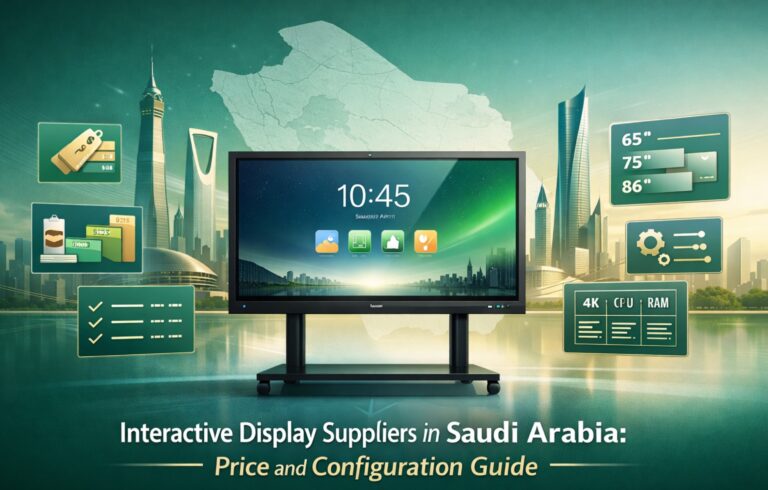
Saudi Arabia is one of the fastest-growing and most influential economies in the Middle East, driven by strong government investment in education, digital infrastructure, and smart transformation under Vision 2030. As a businesswoman who has worked in the smart board and interactive display industry and served the Saudi market for many years, I would like to share practical insights into the local interactive display landscape. In this article, we will explore the Saudi interactive display market, highlight reliable and high-quality suppliers, and break down realistic pricing and configuration options. If you are currently sourcing interactive displays or smart boards in Saudi Arabia, whether for education, corporate, or government projects, this guide will provide valuable, experience-based information to support better purchasing decisions.
Saudi Arabia Interactive Display Market Overview
Saudi Arabia’s interactive display and smart board market is experiencing steady and sustained growth, driven primarily by Vision 2030, large-scale government digitalization initiatives, and rising investment in smart education infrastructure. As one of the most influential economies in the Middle East, Saudi Arabia plays a key role in shaping regional demand for interactive displays across education, public services, and enterprise environments.
From a regional perspective, the Middle East & Africa interactive display market was valued at approximately USD 1.05 billion in 2023 and is projected to reach around USD 1.52 billion by 2031, with a CAGR of about 4.7%. Saudi Arabia is widely recognized as one of the main growth engines within this market, supported by large public-sector budgets and nationwide digital transformation programs.
Education remains the largest demand sector. Saudi Arabia’s edtech market was valued at roughly USD 2.32 billion in 2024 and is growing at an estimated 12–13% annually. Smart classrooms increasingly rely on interactive flat panels and smart boards as core teaching tools. Beyond education, corporate offices, government institutions, healthcare facilities, and smart city projects are also driving demand, particularly for meeting room displays, training systems, and interactive kiosks.
In terms of sourcing, buyers typically choose between local distributors/system integrators and international manufacturers, mainly from China and global brands supplying through Saudi partners. The most requested products in the Saudi market are 65″, 75″, and 86″ interactive displays, commonly configured with Android or Dual OS, IR touch, OPS PCs, and full Arabic-language UI support to meet local requirements.
What Qualifies as a Top Interactive Display Supplier in Saudi Arabia?
A top interactive display supplier in Saudi Arabia must first demonstrate consistent product quality and full certification compliance. This includes meeting SASO requirements for local market access, as well as international standards such as CE and FCC. These certifications are especially critical for government, education, and large enterprise projects, where compliance and safety are strictly audited.
Equally important is local service capability and warranty support. Leading suppliers work with Saudi-based partners, system integrators, or service teams that can provide on-site installation, training, maintenance, and fast-response after-sales service. For public-sector and education deployments covering multiple cities, local technical support is often a decisive factor in supplier selection.
Another key qualification is configuration flexibility with full Arabic system support. Saudi buyers typically require Arabic user interfaces, right-to-left writing support, Arabic fonts, and compatibility with locally used LMS or conferencing platforms. Top suppliers offer multiple size options, touch technologies, OS configurations (Android, Windows, or Dual OS), and modular accessories such as OPS PCs, cameras, and microphones to match different project needs.
Finally, pricing transparency and proven project experience set top suppliers apart—especially for large tenders or customized projects. Reliable suppliers provide clear quotations, detailed BOM breakdowns, realistic lead times, and references from previous Saudi or GCC projects. This level of transparency reduces risk for buyers and ensures smoother execution for high-value, long-term deployments.
Top 10 Interactive Display Suppliers in Saudi Arabia
Below is a curated list of high-quality interactive display suppliers in Saudi Arabia, compiled by the Ikinor market research team based on in-depth field visits, partner interviews, and extensive online data analysis. This overview reflects real market presence, product capabilities, service strength, and project experience within the Kingdom. The suppliers listed here serve key sectors such as education, government, corporate, and smart infrastructure projects. Please note that the ranking is not in any particular order and is provided for reference purposes only. The goal of this list is to help buyers, system integrators, and project owners gain a clearer understanding of the Saudi interactive display landscape and make more informed sourcing and procurement decisions.
Ideal Solution
| Item | Details |
|---|---|
| Company Info | Saudi-based solution provider offering interactive display screens for retail, corporate, and commercial applications. |
| Product Range | Interactive display screens, IFPDs, conference room interactive displays, commercial touch screens |
| Location (City) | Riyadh |
| Core Strengths | Strong system integration capability, multi-industry solutions, local deployment experience |
| Contact | https://idealsolution.sa  |
Saudi Tk
| Item | Details |
|---|---|
| Company Info | Established Saudi distributor specializing in interactive screens for education and business with full local support. |
| Product Range | Business interactive screens, smart boards, conference room IFPs from global brands |
| Location (City) | Riyadh |
| Core Strengths | Full warranty & installation, strong government and enterprise project experience |
| Contact | https://www.sauditk.com |
Smart Unit
| Item | Details |
|---|---|
| Company Info | Provider of smart advertising and interactive screen solutions focused on digital engagement. |
| Product Range | Digital advertising displays, interactive touch screens, digital signage systems |
| Location (City) | Riyadh |
| Core Strengths | Strong content control systems, advertising-focused interactive solutions |
| Contact | https://www.smartunit.sa |
PC Palace
| Item | Details |
|---|---|
| Company Info | Large IT and electronics retailer offering interactive screens from multiple international brands. |
| Product Range | Interactive touch screens, BenQ, Optoma, Spectron interactive displays |
| Location (City) | Multiple cities (nationwide retail network) |
| Core Strengths | Wide brand selection, fast delivery, retail pricing flexibility |
| Contact | https://pcpalace.com.sa |
BoardEX
| Item | Details |
|---|---|
| Company Info | Technology-focused company providing proprietary interactive flat panel display solutions. |
| Product Range | 4K interactive flat panel displays, smart collaboration screens |
| Location (City) | Riyadh |
| Core Strengths | Own product line, modern UI, strong focus on collaboration environments |
| Contact | https://boardextech.com |
Seertech
| Item | Details |
|---|---|
| Company Info | Saudi technology company aligned with Vision 2030, focused on smart education and training solutions. |
| Product Range | ROYA series interactive smart boards, Android-based interactive displays |
| Location (City) | Riyadh |
| Core Strengths | Arabic UI support, education focus, 3-year warranty, Vision 2030 compliance |
| Contact | https://seertech.com.sa |
Ebhar Technology
| Item | Details |
|---|---|
| Company Info | Enterprise and event technology provider offering interactive presentation and display solutions. |
| Product Range | Interactive screens for conferences, exhibitions, and presentations |
| Location (City) | Riyadh |
| Core Strengths | Event deployment expertise, flexible mounting (wall / stand / portrait / landscape) |
| Contact | https://ebhar.com.sa |
Saudi AV Tech
| Item | Details |
|---|---|
| Company Info | Professional AV system integrator specializing in meeting room and collaboration solutions. |
| Product Range | Interactive meeting room displays, MAXHUB IFPs, integrated AV systems |
| Location (City) | Riyadh |
| Core Strengths | Strong AV integration, enterprise-grade solutions, certified products |
| Contact | https://saudiavtech.com |
Y‑TECH
| Item | Details |
|---|---|
| Company Info | IT and smart solution provider offering interactive displays and conferencing equipment. |
| Product Range | Interactive displays, Yealink video bars, smart meeting room systems |
| Location (City) | Riyadh |
| Core Strengths | Broad IT ecosystem, strong brand partnerships, smart collaboration focus |
| Contact | https://ytech-sa.com |
MAJESTY TECHNOLOGY
| Item | Details |
|---|---|
| Company Info | Saudi-based supplier focusing on high-performance interactive touch displays for education and enterprise use. |
| Product Range | 4K interactive touch screens, smart boards, dual-system displays (Android 13 + Windows 11), up to 86″ |
| Location (City) | Riyadh |
| Core Strengths | High-end configurations, Intel i7 OPS, 16GB RAM, premium positioning |
| Contact | https://majestytechnology.com |
Interactive Display Price Range in Saudi Arabia
Interactive display pricing in Saudi Arabia varies widely depending on screen size, brand positioning, configuration, and sourcing model. Based on current market data from major Saudi retailers, distributors, and e-commerce platforms, the following price ranges are commonly observed.
Average price by screen size
- 21.5″–32″ portable / mobile touch displays: SAR 1,300 – 2,700
(Often Android-based, battery-powered, used for retail or events) - 55″ interactive displays: SAR 5,000 – 8,500
- 65″ interactive displays: SAR 3,800 – 10,500
- 75″ interactive displays: SAR 5,800 – 12,500
- 86″ interactive displays: SAR 7,000 – 18,500
- 98″ interactive displays: SAR 12,500 – 24,000+
Brand vs. OEM pricing
Global brands such as Samsung, Huawei, BenQ, and Ricoh typically sit at the higher end of the price range, driven by brand premium, local marketing, and bundled services. OEM or less well-known brands—often sourced from China and sold through Saudi distributors—offer more aggressive pricing, especially for education and large-volume projects.
Air-gap vs. zero bonding
Most displays sold in Saudi Arabia use standard air-gap bonding, which keeps prices competitive and suits most education and corporate needs. Zero bonding models usually carry a 10–25% price premium, targeting high-end classrooms, executive boardrooms, and flagship government projects.
Local stock vs. custom orders
Locally stocked products are priced higher but offer fast delivery. Custom or OEM orders—especially for large tenders—can significantly reduce unit cost, though they require longer lead times and clearer configuration planning.
Configuration Options Offered by Leading Suppliers
Leading interactive display suppliers in Saudi Arabia offer a wide range of configuration options to meet the needs of education, corporate, and government projects. One of the most important choices is touch technology. IR touch remains the most widely adopted option due to its cost efficiency, durability, and suitability for classrooms. PCAP touch, while more expensive, is increasingly used in premium meeting rooms and high-end projects where smoother touch response and higher precision are required.
Operating system options are another key configuration factor. Most suppliers offer Android-based systems as standard, providing built-in whiteboard software, wireless casting, and app support. For advanced applications, displays can be equipped with Windows OS via OPS PC, enabling full compatibility with Microsoft Office, Zoom, Teams, and industry-specific software. Many projects now prefer Dual OS configurations, allowing users to switch between Android and Windows depending on usage scenarios.
Hardware modules further enhance functionality. Common options include OPS PCs (Intel i5/i7), 4K cameras, beamforming microphones, and front-facing speakers or soundbars, making interactive displays suitable for video conferencing, hybrid learning, and training environments without additional external devices.
In terms of ports and connectivity, leading suppliers typically provide HDMI, USB-A, USB-C, LAN (RJ45), Audio In/Out, and sometimes RS232 or TF card slots. USB-C is increasingly important for one-cable display, touch, power, and data transmission.
Finally, Arabic UI, branding, and software customization are critical in Saudi Arabia. Top suppliers support Arabic-language interfaces, right-to-left writing, custom boot logos, UI themes, and integration with locally used LMS or CMS platforms—especially for government and large-scale education projects.
Local Saudi Suppliers vs. Overseas Manufacturers
When sourcing interactive displays in Saudi Arabia, buyers typically choose between local Saudi suppliers and overseas manufacturers, most commonly from China. Each option offers distinct advantages depending on project size, budget, and customization requirements.
Buying from local Saudi suppliers provides clear benefits in terms of convenience and risk reduction. Local partners offer faster delivery from existing stock, on-site installation, Arabic-speaking technical support, and easier warranty handling. For government projects, education tenders, or time-sensitive deployments, working with a Saudi-based distributor or system integrator simplifies compliance with local regulations, SASO requirements, and after-sales expectations.
On the other hand, China-based manufacturers offer strong advantages in cost efficiency and IFDP OEM/ODM customization, especially for large-scale or long-term projects. Chinese factories benefit from mature supply chains, competitive component pricing, and deep manufacturing experience. This allows them to deliver lower unit costs, flexible hardware configurations, custom UI/firmware, branding, packaging, and even structural design changes—capabilities that local resellers often cannot provide at the same depth or price level.
In terms of lead time and MOQ, local suppliers typically support small quantities with immediate availability, while overseas manufacturers require longer lead times and higher minimum order quantities. However, for volume projects, overseas sourcing often results in better pricing and more consistent configurations.
For many large education or government projects, a hybrid sourcing model is increasingly common. In this approach, displays are manufactured and customized in China, then delivered to Saudi Arabia through local partners who handle certification, installation, and after-sales service—combining cost advantages with local support.
How to Choose the Right Supplier for Your Project
Choosing the right interactive display supplier in Saudi Arabia starts with clearly understanding your project type and usage scenario. Education projects often prioritize durability, ease of use, Arabic teaching tools, and cost control for large classroom deployments. Corporate projects focus more on presentation quality, video conferencing performance, and design aesthetics, while government projects typically require strict compliance, long warranties, and proven supplier credentials.
Budget planning and ROI are equally important. For large-scale deployments, it is critical to look beyond the unit price and consider long-term value, including lifespan, maintenance costs, software updates, and energy efficiency. Lower-priced displays may reduce upfront investment but could lead to higher operating or replacement costs over time. A reliable supplier should help you balance initial cost with total cost of ownership.
After-sales service and long-term support often become deciding factors. Strong suppliers offer local technical support, spare parts availability, clear warranty terms, and responsive service teams. For nationwide or multi-year projects, the ability to provide consistent support across different locations is essential.
Finally, consider when to choose standard displays versus premium zero bonding models. Standard air-gap interactive displays meet the needs of most classrooms and meeting rooms at a competitive price point. Zero bonding displays, while more expensive, are better suited for executive boardrooms, flagship classrooms, and high-visibility government projects where visual clarity, touch precision, and premium design justify the investment. The right supplier should guide you honestly toward the most appropriate technology for your project—not simply the most expensive option.
Offline Trade Shows in Saudi Arabia to Find Interactive Display Suppliers
If you are looking to connect with interactive display and smart board suppliers through offline channels in Saudi Arabia, attending the right trade shows is one of the most effective approaches. These exhibitions bring together local distributors, system integrators, government contractors, and international manufacturers serving the Saudi market.
| Exhibition | Positioning | Suitable Suppliers to Find | Why It’s Worth Attending |
|---|---|---|---|
| GESS Saudi Arabia(Global Educational Supplies & Solutions) | Education technology & smart campus solutions | Interactive displays / Smart boardsClassroom digital solutionsEdTech software + hardware integrators | GESS is Saudi Arabia’s most important education-focused exhibition. Many interactive display suppliers showcase classroom IFPs, smart boards, and integrated teaching solutions, making it ideal for Ministry of Education projects, universities, and international schools. |
| Saudi Light & Sound Expo | Professional AV & commercial display | Interactive flat panelsConference room displaysControl room / command center solutions | One of the most professional AV exhibitions in Saudi Arabia, gathering local system integrators, AV engineering companies, and global display brands. Highly suitable for corporate meeting rooms, government projects, and control center applications. |
| LEAP Tech Conference | National-level technology & digital transformation event | High-end interactive displaysSmart city & government digital solutionsCustom OEM/ODM partners | A flagship Vision 2030-supported tech event. Although not display-focused, LEAP attracts government contractors, system integrators, and premium solution providers—ideal for large-scale customization projects and long-term partnerships. |



 English
  Spanish
  Arabic
  French
  Indonesian
  German
  Portuguese
  Russian
  Vietnamese
  Thai
Thai  Italian