
Modern meetings have evolved from purely in-person interactions to a hybrid model that combines remote and on-site collaboration. As technology continues to advance, audio-visual systems have significantly improved, making communication more seamless, engaging, and efficient than ever before. Among these innovations, meeting room display solutions have become one of the most critical components, enabling better presentations, real-time collaboration, and smoother decision-making. Today, businesses have access to a wide range of display technologies, each designed to meet different needs and environments. In this article, we’ll explore the top 5 meeting room display solutions you can learn from to upgrade your workspace.
Why Meeting Room Display Solutions Matter in Modern Workspaces
Meeting efficiency plays a critical role in overall business performance. In modern organizations, decisions are often made through meetings, and the speed and clarity of communication can directly impact productivity, execution, and results. As businesses handle increasingly complex information, relying on verbal explanations alone is no longer enough—many key ideas need to be delivered through clear visual presentation.
Today, companies frequently use visual content such as data dashboards, presentations, product demos, and real-time analytics to support discussions. This shift has made meeting room display solutions an essential part of the workplace, helping teams better understand information and stay aligned.
The technology itself has also evolved significantly. Traditional projectors, once the standard, are now being replaced by more advanced solutions like interactive displays, which offer higher resolution, touch functionality, and seamless connectivity. Unlike projectors, these modern displays allow users to annotate, collaborate, and share content instantly, making meetings far more dynamic and engaging.
More importantly, meeting room displays have become key tools for improving communication and collaboration. Teams can present ideas more clearly, interact with content in real time, and involve both in-person and remote participants effectively. This leads to faster decision-making, fewer misunderstandings, and more productive outcomes.
In short, upgrading meeting room display solutions is no longer just a technical improvement—it is a strategic step toward building a smarter, more efficient workplace.
Meeting Room Display Solution 1: Interactive Flat Panel Displays (IFPD): The All-in-One Collaboration Hub
The first solution worth highlighting is the Interactive Flat Panel Display (IFPD), which has quickly become one of the most popular meeting room technologies. As an all-in-one audio-visual device, an IFPD combines display, audio, and camera capabilities into a single system, eliminating the need for multiple separate devices.
Unlike traditional displays, IFPDs are designed for full collaboration. They integrate touchscreen interaction, digital whiteboarding, and video conferencing into one seamless platform. Teams can present content, annotate directly on the screen, brainstorm ideas in real time, and instantly share notes, making meetings far more interactive and productive.
Another key advantage is wireless screen sharing. Participants can easily cast their screens from laptops, tablets, or smartphones without dealing with cables or complex setups. This feature is especially valuable in hybrid meetings, where both in-room and remote participants need to collaborate efficiently.
IFPDs are particularly well-suited for medium to large meeting rooms, training centers, and corporate collaboration spaces. Their large screen sizes (commonly 65″, 75″, or 86″) ensure clear visibility for all participants, while built-in microphones and cameras support high-quality video conferencing.
Overall, IFPDs are not just display devices—they are comprehensive collaboration hubs that streamline communication, reduce equipment complexity, and significantly enhance meeting efficiency in modern workplaces.

Meeting Room Display Solution 2: Digital Whiteboard + Projector
The combination of a digital whiteboard and projector remains a practical and cost-effective meeting room display solution, especially for organizations that are transitioning from traditional setups. While newer technologies like interactive displays are gaining popularity, this solution still offers strong value for many business environments.
A digital whiteboard paired with a projector allows teams to present visual content while maintaining the flexibility of writing and annotation. Presenters can project slides, documents, or data onto a large surface, and then use the whiteboard to highlight key points, draw diagrams, or explain ideas in real time. This combination supports both structured presentations and spontaneous collaboration.
One of the main advantages of this setup is its affordability and familiarity. Many teams are already comfortable using projectors and whiteboards, which means there is little to no learning curve. It is also easier to upgrade existing meeting rooms by adding digital tools to a traditional whiteboard environment rather than replacing the entire system.
However, compared to modern solutions, this setup may require more manual operation, such as adjusting the projector, managing cables, and ensuring proper alignment. Despite this, it remains a reliable choice for small to medium-sized meeting rooms, classrooms, and training spaces where budget and simplicity are key considerations.
Overall, the digital whiteboard and projector combination provides a balanced solution that blends traditional presentation methods with digital capabilities.

Meeting Room Display Solution 3: Digital Signage for Meeting Rooms: Smart Scheduling and Communication
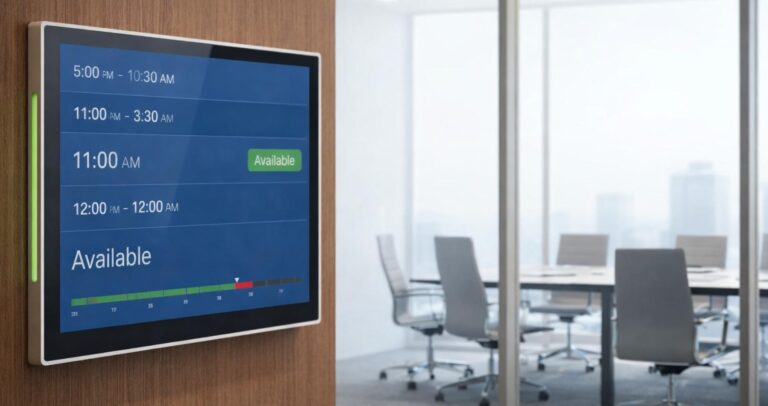
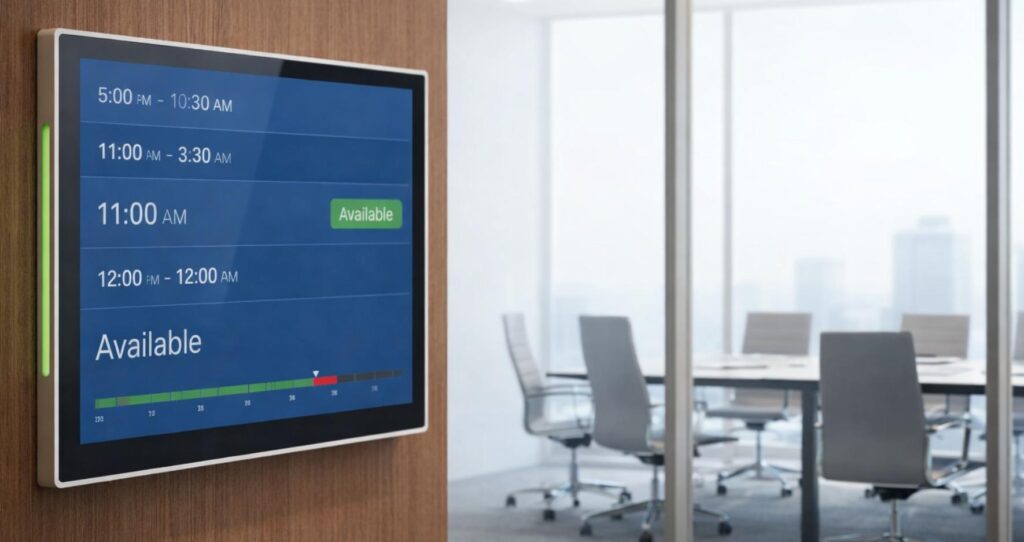
Digital signage designed for meeting rooms plays a crucial role in improving workplace organization and communication. Often installed outside meeting rooms as room booking displays, these screens provide real-time information about room availability, scheduled meetings, and current usage status.
One of the biggest advantages of this solution is real-time visibility. Employees can instantly see whether a room is occupied, when the next meeting starts, and how long the room will be available. This helps eliminate confusion, reduce double bookings, and improve overall space utilization within the office.
Another key feature is seamless integration with calendar systems such as Microsoft Outlook and Google Calendar. Once connected, the display automatically syncs meeting schedules, ensuring that all information is always up to date. Users can also book or release meeting rooms directly from the screen, making the process faster and more convenient.
Digital signage for meeting rooms also enhances communication by displaying additional information, such as company announcements, meeting reminders, or room-specific instructions. This turns a simple display into a smart communication tool that supports daily operations.
Overall, this solution is ideal for corporate offices, co-working spaces, and large organizations where multiple meeting rooms are in constant use. By combining scheduling, visibility, and communication in one system, digital signage helps create a more efficient and organized workplace environment.
Meeting Room Display Solution 4:LED Display Walls: High-Impact Visual Experience
LED display walls represent one of the most advanced meeting room display solutions, especially for organizations that require a powerful and visually impactful presentation environment. Unlike traditional screens, LED walls are built using modular panels that can be seamlessly connected to create ultra-large displays without visible gaps, delivering a truly immersive viewing experience.
One of the key advantages of LED display walls is their scalability and size flexibility. Whether for a large conference room, executive briefing center, or corporate presentation hall, these displays can be customized to fit almost any space. This makes them particularly suitable for large-scale meetings with multiple participants, where visibility and clarity are critical.
In addition to size, LED walls offer exceptional image quality, including high brightness, vibrant colors, and wide viewing angles. Even in well-lit environments, content remains sharp and easy to read, ensuring that every participant—regardless of where they are seated—can clearly see the presentation.
More importantly, LED display walls create a highly immersive visual experience. They are ideal for showcasing complex data, large-scale visuals, and dynamic multimedia content, helping teams communicate ideas more effectively. This level of visual impact is especially valuable for high-stakes presentations, client meetings, and strategic decision-making sessions.
Overall, LED display walls are best suited for premium meeting spaces and large collaborative environments, where delivering a strong visual impression and engaging a wide audience are top priorities.
Meeting Room Display Solution 5: Portable Smart TV
Portable smart TVs have emerged as a flexible and cost-effective meeting room display solution, especially for businesses that require mobility and adaptability. Unlike fixed installations, these devices are designed to be easily movable, often equipped with wheels or adjustable stands, allowing teams to use them across different rooms or workspaces as needed. For businesses looking for a more flexible collaboration setup, a Portable Smart Meeting Screen can provide a mobile display solution for meeting rooms, training spaces, and temporary work areas.
One of the key advantages of portable smart TVs is their low budget requirement compared to traditional AV systems or large interactive displays. For startups, small businesses, or temporary setups, they offer a practical way to upgrade meeting capabilities without heavy investment. Despite the lower cost, they still provide a wide range of features.
Modern portable smart TVs are highly multifunctional. They typically come with built-in operating systems (such as Android), enabling users to run apps, access cloud content, and support wireless screen sharing. Some models also include touch functionality, cameras, and microphones, making them suitable for video conferencing and collaborative work.
Their portability makes them ideal for flexible work environments, such as co-working spaces, small meeting rooms, training sessions, or even temporary project areas. Teams can quickly move the display to where it is needed, reducing dependency on fixed meeting room infrastructure.
Overall, portable smart TVs provide a balanced solution that combines affordability, flexibility, and functionality. They are particularly valuable for organizations looking to create agile meeting spaces without committing to permanent and high-cost installations.
How to Choose the Right Meeting Room Display Solution
Choosing the right meeting room display solution depends on several key factors, starting with the size and purpose of the meeting space. For large conference rooms or boardrooms, bigger and more powerful displays are essential. In these cases, a 98-inch or 100-inch interactive display or even an LED wall is recommended to ensure clear visibility for all participants. For medium-sized rooms, interactive flat panel displays are often sufficient, while smaller spaces can benefit from more compact and flexible solutions.
Compatibility is another critical consideration. The display system should work seamlessly with your existing devices and software, including laptops, video conferencing platforms, and operating systems such as Windows or Android. Features like wireless screen sharing and integration with collaboration tools can significantly improve usability and efficiency.
Budget and long-term return on investment (ROI) also play an important role. While high-end solutions like LED walls offer impressive performance, they require a larger upfront investment. For businesses with limited budgets, a portable smart TV can serve as a practical transitional solution, providing essential functionality at a lower cost while still supporting modern meeting needs.
Finally, it’s important to consider whether the solution supports customization and scalability. As your business grows, your meeting requirements may change. Choosing a system that can be upgraded, expanded, or customized ensures long-term value and avoids the need for complete replacement in the future.
In summary, the best solution is one that balances performance, compatibility, budget, and flexibility.



 English
  Spanish
  Arabic
  French
  Indonesian
  German
  Portuguese
  Russian
  Vietnamese
  Thai
Thai  Italian