
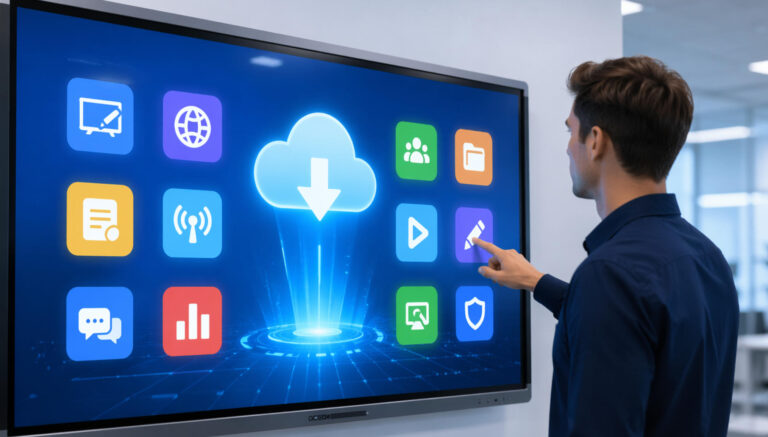
Interactive displays are no longer just presentation tools—they are evolving into powerful content recording platforms. More and more organizations are looking for ways to capture lessons and meetings efficiently without complex setups. That’s where built-in recording systems come in. By integrating video, audio, and screen capture into one device, they simplify the entire process and improve usability. In this article, we’ll explore how recording systems on interactive displays work and why they are becoming essential.
What Is a Recording System on Interactive Display?
A Recording System on Interactive Display refers to a lecture capture solution that is either built directly into an interactive display / smart board or deeply integrated with it. Unlike traditional setups that rely on multiple separate devices, this approach uses an all-in-one design to simplify both operation and deployment.
In terms of functionality, these systems offer powerful multi-source capture capabilities. They can simultaneously record different types of content, including the instructor’s video (via camera), audio (via microphone), presentation materials such as PPT or screen content, and all interactions on the interactive whiteboard, such as writing, annotations, and demonstrations. This ensures that everything happening during a lesson or meeting is captured in a synchronized and complete way.
Another key feature is automatic integration and cloud-based storage. The system can combine all recorded elements into a complete video without the need for manual editing, and then upload it to a cloud platform for easy access and playback anytime.
Because of these capabilities, such systems can effectively function as full lecture capture systems, widely used in smart classrooms, corporate training, and remote learning environments.
At its core, this solution transforms one-time teaching or meeting sessions into reusable digital content assets, significantly improving knowledge sharing and long-term value.
Key Features of Interactive Display Recording Systems
Modern recording systems built into interactive displays are designed to simplify workflows while enhancing functionality through integration and intelligence.
All-in-One Integration
One of the biggest advantages is the all-in-one design, combining display, touch interaction, recording, and live streaming into a single device. This eliminates the need for multiple external devices such as capture cards, separate PCs, or complex AV setups, resulting in a cleaner, more efficient environment.
Multi-Source Capture
These systems support multi-source recording, capturing different types of content simultaneously. This includes the instructor’s video via camera, audio through microphones, presentation materials like PPT or screen content, and interactive whiteboard inputs such as writing and annotations. The result is a fully synchronized recording of the entire session.
AI-Powered Automation
With the integration of AI, recording systems have become more intelligent. Features such as auto-tracking of the speaker, automatic scene switching between presenter and content, and AI-generated subtitles or transcription are now becoming standard, improving both production quality and viewer experience.
Cloud & LMS Integration
Another key feature is seamless integration with cloud platforms and LMS systems like Moodle or Canvas. Recorded content can be automatically uploaded, organized, and distributed, making it easy for users to access and manage learning materials anytime, anywhere.
Top 6 Interactive Display Brands with Recording Systems
| Brand | Introduction | Recording System Capability | Overall Evaluation |
|---|---|---|---|
| Promethean | Global education technology brand focused on K12. ActivPanel widely used in smart classrooms. | Built-in screen recording, lesson capture, integrates with teaching software ecosystem | ⭐⭐⭐⭐⭐ Strong in education, mature ecosystem, but higher cost and less flexible |
| Hisense Commercial Display | Large Chinese manufacturer offering all-in-one display solutions for business and education. | Basic recording via meeting systems, supports content saving and playback | ⭐⭐⭐⭐☆ Strong hardware, but recording system not deeply integrated |
| Speechi | French brand specializing in interactive whiteboards for education. | Supports lesson recording and whiteboard content saving/export | ⭐⭐⭐⭐☆ Easy to use, education-focused, moderate integration level |
| ViewSonic (ViewBoard) | Global display brand serving both education and business markets. | Screen recording, whiteboard saving, cloud integration support | ⭐⭐⭐⭐⭐ Balanced hardware + software, versatile for multiple scenarios |
| Avocor | Premium collaboration display brand focusing on enterprise and Microsoft ecosystem. | Recording mainly relies on Teams/Zoom cloud recording | ⭐⭐⭐⭐☆ Strong for meetings, but depends on third-party software for recording |
| Ikinor | OEM/ODM interactive display manufacturer with strong customization capability. | Built-in recording system, one-touch recording, multi-source capture, AI tracking, AI editing, cloud & live streaming integration | ⭐⭐⭐⭐⭐ Highly integrated, AI-powered, cost-effective and customizable |
How Recording Systems Empower Education & Business
Recording systems built into interactive displays are transforming how knowledge is delivered, stored, and reused across both education and business environments.
Education Sector
In education, recording systems enable repeatable learning. Students can pause, rewind, and revisit lessons at their own pace, improving understanding and retention. They also play a key role in hybrid learning, allowing institutions to combine in-person and remote teaching seamlessly. Even if students miss a class, they can access recorded content anytime, ensuring continuity. Overall, this leads to higher teaching quality and more flexible learning experiences.
Corporate Training
For businesses, recording systems help create standardized training content. Instead of repeating the same sessions, companies can record once and reuse the material across teams and locations. This significantly reduces training costs and improves efficiency. Over time, organizations can build a structured knowledge base, making onboarding and skill development more scalable and consistent.
Content as an Asset (Key Trend)
A major shift is the transformation of teaching content into valuable digital assets. Lessons and training sessions are no longer temporary—they become reusable products that can be distributed, monetized, or repurposed. In addition, recorded content can serve as training data for AI systems, enabling intelligent analysis, automated summaries, and even AI-driven learning tools.
Overall, recording systems are not just tools—they are becoming the foundation for modern knowledge management and digital transformation.
Final Thoughts
Traditional lecture capture systems often rely on multiple devices and complex setups—including cameras, PCs, capture cards, and separate software. This not only increases installation difficulty but also creates challenges in daily use and maintenance.
In contrast, the new generation of solutions is built around interactive display + AI + cloud integration. By combining recording, presentation, interaction, and content management into a single platform, these systems significantly simplify workflows while improving performance and scalability. Features like AI-powered tracking, automatic recording, and cloud-based distribution are redefining how lessons and meetings are captured and shared.
For organizations planning large-scale deployments, choosing the right partner is crucial. Working with a reliable smart board manufacturer ensures better system integration, long-term support, and customization options tailored to your needs.
If you are exploring interactive display–based lecture capture solutions, Ikinor offers integrated, AI-driven systems designed for both education and business environments. Feel free to contact us for more information or to discuss your project requirements.



 English
  Spanish
  Arabic
  French
  Indonesian
  German
  Portuguese
  Russian
  Vietnamese
  Thai
Thai  Italian